
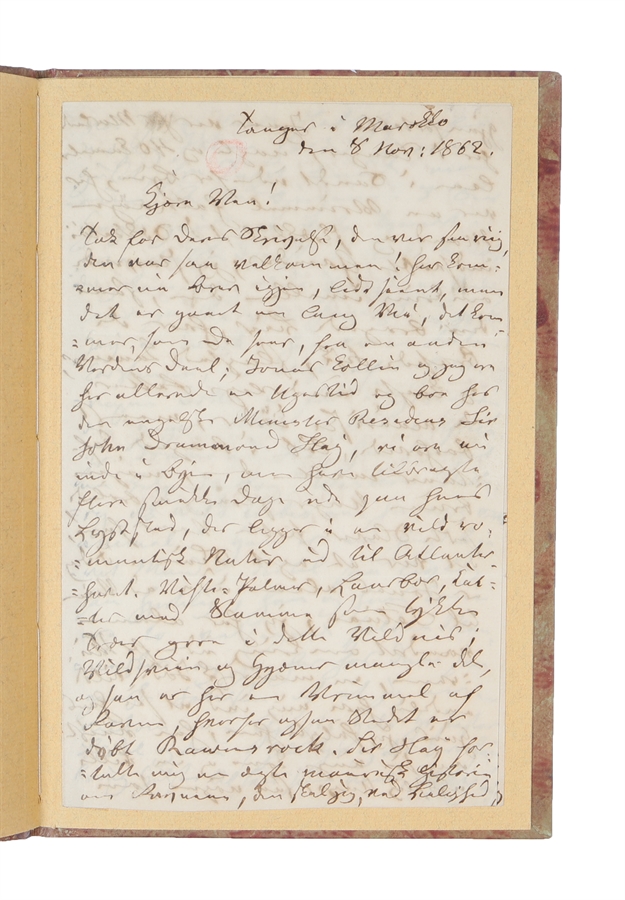
Dated "Tanger I Marokko/ den 8 Nov: 1862."
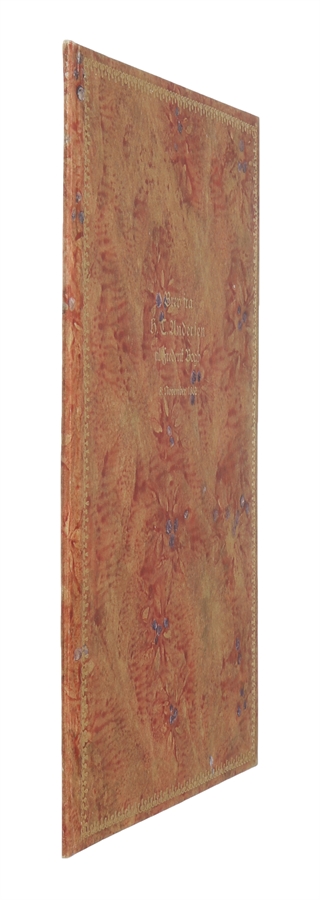
2 ½ pages 8vo. In a beautiful marbled paper binding with gilt ornamental borders to boards and gilt lettering to front board (signed Rigmor Birkedal Kragh). A small paper flaw (presumably from the opening of the letter) and slight discolouration at inner hinge of f. 2, where the letter is attached in the binding. Otherwise in excellent condition.
An absolutely splendid original hand-written letter from Hans Christian Andersen to his close friend Frederik Bøgh with rare observations about Moroccan culture, the people, how they dress and behave, the food, the landscape, etc. It is clear that Tanger, with its “wild, romantic nature”, its palm trees, its wilderness, the wild boars and hyenas, is very far from the coldness of the North. Andersen’s fascination – with the “half-naked men” and women in horrible dress, with the bareheaded Moorish Jews in kaftans, “the naked brown kids that screamed and roared”, and the slaves that carry goods – leaps from the pages of the letter and paints a picture of a place that to a Dane in 1862 must seem oddly fascinating and so different. There is no doubt that this rich culture served as inspiration for Andersen (who already in 1840 had written the play “The Moorish Girl”), who specifically mentions “a real Moorish story about the ravens that I will recount when given the chance”. The letter is registered in the Andersen letter database. The contents follow here: “Kjære Ven! Tak for Deres Skrivelse, den var saa rig, den var saa velkommen! her kommer nu Brev igjen, lidt seent, men det er gaaet en lang Vei, det kommer, som De seer, fra en anden Verdens Deel; Jonas Collin og jeg ere her allerede en Ugestid og boe hos den engelske Minister Residens Sir John Drummond Hay, vi ere nu inde i Byen, men have tilbragte flere smukke Dage ude paa hans Lyststed, der ligger i en vild romantisk Natur ud til Atlanterhavet. Vifte-Palmer, Laurbær, Cacter med Stamme som trykke Træer groe i dette Vildnis; Vildsviin og Hyæner mangle ikke, og saa er her en Vrimmel af Ravne, hvorfor ogsaa Stedet er døbt Ravensrock. Sir Hay fortalte mig en ægte maurisk Historie om Ravnene, den skal jeg, ved Leilighed gjenfortælle. Igaar var her Marked her i Tanger, nogle og 40 Kameler laae i Sandet uden for Byen; her var en Vrimmel, halvnøgne Mænd og skrækkeligt i Sækketøi indsvøbte Qvinder; jeg stavrede omkring mellem de, saae den brogede Leir, hvor de brasede Fisk, slagtede Kaniner og kogte underlige Retter. De mauriske Jøder, meest barhovede, løb i brogede Kaftaner mellem dem, nøgne brune Unger skreeg og brølede, sorte Slaver slæbte Varer frem, det var et eget Skue. I Dag er Jonas alene ude ad Veien til Tetuan, jeg har aleene vandret omkring uden for Murene, en maurisk Jøde vilde endelig have mig ind at see hans Huus, jeg fulgte ham, han viiste mig sin unge Kone og en Lille nysselig Unge, saa nøgen som vor Herre havde skabt ham. En mægtig Palme hældede sig over Huset, fra Taget kunde man øine Atlasbjergne. I Sir Hays Huus ere hele Tyendet i orientalsk Dragt, de tale arabisk, dog kan Een lidt Spansk en Anden taler ganske godt Engelsk. - Fru Hay er Dansk, hun er en Frøken Carstensen, den ældste af de halvvoxne Døttre er født i Kjøbenhavn, den yngere Alice er født i Africa. Hr. Drumond Hay har skrevet en bekjendt Bog, 'Western Barbary, its wild tribes and savage animal.' Han er en høit begavet Mand, dertil saa livlig saa hjertelig, han og hans Kone ere to velsignede sjældne Mennesker og jeg har hos dem saa ganske Følelsen af at jeg er en velkommen Gjæst. Hils Hr Pastor Blædel og Frue, Hils Hr og Fru Jerichau, bring Hilsen til hver som venlig erindrer mig Glæd mig i Madrid med Brev, adressert der til den danske Minister. Seer De Scharff og Eckard da hils! Deres hjerteligt hengivne H.C. Andersen I Eftermiddag skal jeg besøge Paschaen af Tanger, det vil vist blive ganske interessant, han veed at Collin og jeg komme med minister, alle Damerne ere flyttet til en anden Fløi af Slottet, dem faae vi ikke at see, kun den mandlige Befolkning.” [Address]: ”Til Hr Frederik Bøgh boer hos Hr Pastor Blædel, Sognepræst til Garnisonskirken. Garnisonsplads. Kjøbenhavn” Frederik Bøgh (1836-82) was born into a literary and artistic home North of Copenhagen. His uncle was a priest at Garnisonskirken in Copenhagen, and at the age of nine, Frederik was sent off to a good school in Copenhagen, where he could live with his family. It was here, in Copenhagen and at the vicarage where many famous people of the period often gathered, that he met Hans Christian Andersen, to whom he grew very close. Andersen recognized true potential in Bøgh, who sadly died at the age of 48, after almost a decade of being ill. His last ten years were not good and put a stop to his otherwise promising literary career. Frederik had a keen interest in literature, which only grew stronger through his meetings with the literary nobility of Copenhagen. On his 25th birthday, November 4th 1861, he published a work called Valkyrien. The book was quite well received, but it was published anonymously, and the identity of the author was the object to many a speculation. In his diary, Andersen writes on November 10 1861: “I found out for sure that 'Valkyrien' was by the young Bøgh! It is a particularly promising work.” Andersen is very impressed with the young budding author, and Frederik, of course, is overwhelmed by the kindness of the greatest Danish writer, whom everyone had grown to admire. In a letter on November 18, Frederik writes to his parents: “On this occasion, H.C. Andersen has met me with overwhelming love. He had quite loosely heard that I was said to be the author, and when he had read the book, he immediately sat down to write to the author; but where was he to deliver it [i.e. the letter]? After that he had gone to Collins and said 'I know from a reliable source that it is him – ay, I will run there immediately'. 'You cannot do that', Collin had said, what if it is not true. Think of the uncomfortable position you will put the young man in!' After that, he had wandered back and forth in front of a certain vicarage in Bredgade, without the courage to enter. And yet – next morning he came, but he did not find me home, and I went to him. He received me with the extraordinary cordiality that is so peculiar to him: 'First I must tell you that I do not like these heroic women, who lack all femininity. So, I then began reading the book with great reluctance; but when I had read a bit, I said to myself: “But he is brilliant!”, and the more I read, the more I was overcome by joy. Your book is quite poetical. It is the most important that has appeared since it went quiet [i.e. since the great author Oehlenschläger died in 1850]. All the others have twittered as little birds; but you give more, you give something objectively. I am so very pleased about that; that is wonderful, and now, you will see, the sunshine will come, it will come!' and then he pressed both of my hands so warmly, looked me in the eyes so lovingly, got tears in the eye – and I too. We felt good about each other, and happy and pleased I left him.” The warm bond between Frederik Bøgh and Andersen can be traced back to this moment. And from then on, a close friendship evolves, which is evident from their correspondence. And although the young author showed such great promise, he did not publish another book in his lifetime.
Order-nr.: 63547