
![La structure de l'inconscient. [Extrait des Archives de Psychologie, T. XVI, N. 62 (décembre 1916)].](/images/fancy/63295b.jpg)
![La structure de l'inconscient. [Extrait des Archives de Psychologie, T. XVI, N. 62 (décembre 1916)].](/images/fancy/63295c.jpg)
(Genève, Kundig), 1916.
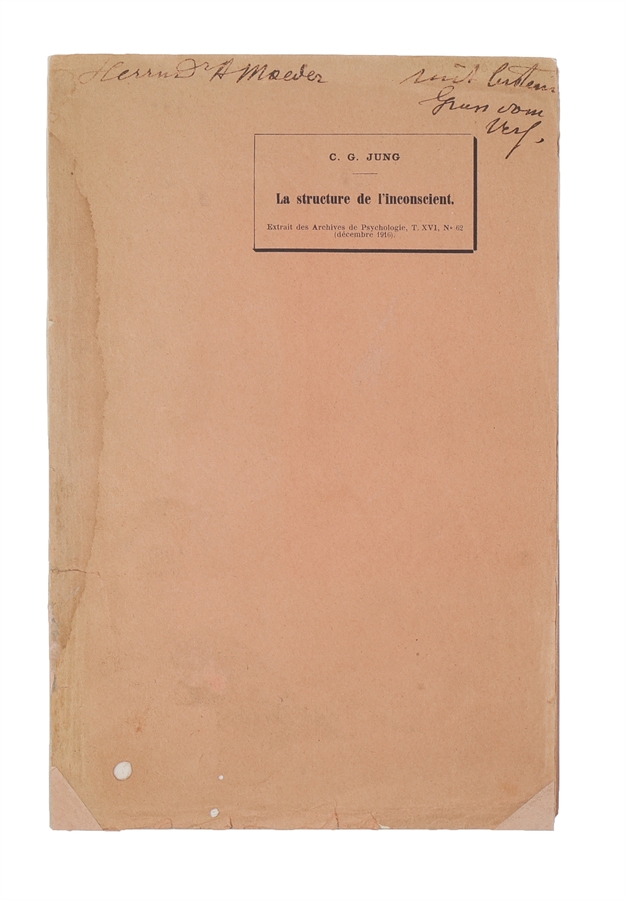
8vo. Original printed orange wrappers. Spine restored, with new paper and new edges. Parts of blank paper towards hinge of back wrapper missing (but with new paper spine in matching paper underneath). A damp stain to front wrapper, towards hinge, some smaller spts, and some small nicks and creases to extremities. A very mild damp stain to inner blank margin of first quire. Pp. (152)-179. Inscribed by Jung to upper front wrapper: "Herrn Dr. A Maeder / mit besten / Gruss vom / Verf."
Scarce first printing, off-print, presentation-copy from Jung to Maeder, of this seminal paper, which contains the very first written appearance of the term "collective unconscious", a concept which is “one of the pillars of the Jungian model of the psyche” (Boechat). This paper is the core of what would later become Die Beziehungen zwischen dem Ich und dem Unbewussten (EN: "The Relations between the Ego and the Unconscious", 1928). The renowned psychiatrist and psychoanalyst Carl Jung (1875-1961) first introduced the term "collective unconscious" in 1916 in a talk to the Zurich School for Analytical Psychology, with the title "Uber das Unbewesste und seine Inhalte". The earliest written appearance of the term was found in the present work, a French translation of the Zurich talk, published in 1916 in the Archives de Psychologies (Tresan 2005: 313). The main chapters of this early work are: I. Distinction de l'inconscient personnel et de l'inconscient impersonnel ("Distinction between the personal unconscious and the impersonal unconscious"); II. Les phénomènes subséquents à l'assimilation d l'inconscient ("Phenomena subsequent to the assimilation of the unconscious"); III. La personne considérée comme segment de la psyché collective ("The person considered as a segment of the collective psyche"); IV. Comment l'individualité essaye de se libérer de la psyché collective ("How individuality tries to free itself from the collective psyche"). Jung's notion of the collective unconscious “ranges from a passive repository that records the history of all human reactions to the world to an active substratum that is the ground out of which all reality emerges. The components of the collective unconscious were first said by Jung to be primordial ancestral images and later archetypes that manifest in consciousness through images, strong affects, and behavioral patterns. When the energies of the collective unconscious break through into consciousness, consciousness itself is altered, and reactions vary from insanity to a significant reordering of major attitudes" (Tresan 2005: 313) The notion first came to Jung “from a dream he had in 1909 on board a ship returning from the United States with Freud. The dream depicted a house that had a cellar bellow the normal cellar and below that a repository of prehistoric pottery, bones, and skulls." (Tresan 20025). The first cellar represented the personal unconscious, and Jung expected Freud to accept the "cellars below this cellar" (Tresan 2005). However, "Freud acknowledged primordial ancestral patterns but regarded them as simply inheritable traits (Lamarckianism) posited in each individual (the biogenetic law). For Freud such experiences were phylogenetic recapitulations unrelated to a transcendent structure such as the collective unconscious, but for Jung they arise anew from the collective unconscious in each person in each instance just as they did in one's ancestors" (Tresan 2005). Jung's formulation of the theory of the collective unconscious went through various phases. According to Boechat, its beginnings can be traced back to “the first moments of Jung’s creative journey during the period he was working as a psychiatrist at the Burghölzli Hospital" (see Boechat), i.e. between 1900 and 1909. Alphonse Maeder (1882-1971) worked under Jung in the Burghölzli hospital and became a close cooperator and friend of Jung; and he broke with Sigmund Freud in 1913. Boechat, Walter. The Collective Unconscious. https://iaap.org/jung-analytical-psychology/short-articles-on-analytical-psychology/the-collective-unconscious-2/ (Accessed 15.06.26) Tresan, David. (2005). Collective Unconscious. In Alain de Mijolla (ed.), The International Dictionary of Psychoanalysis (pp. 312-314). New York: Thomson Gale.
Sources:
Order-nr.: 63295