
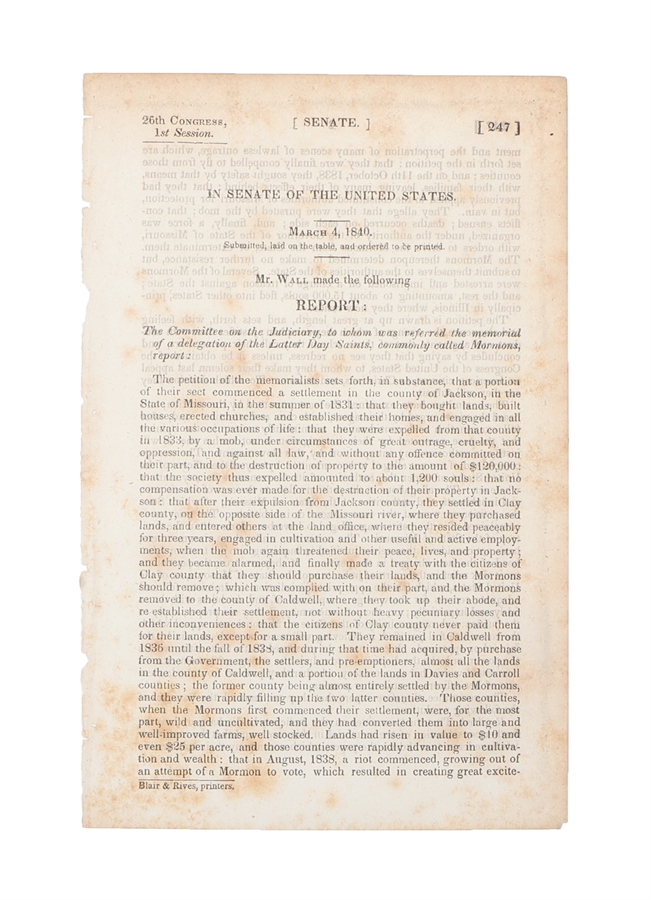
![Report: The Committee on the Judiciary, to whom was referred the memorial of a delegation of the Latter Day Saints, commonly called Mormons. [In Senate of the United States, March 4, 1840. 26th Congress, 1st Session].](/images/fancy/63277b.jpg)
(Washington, D.C., Blair & Rives), 1840.
8vo (222 x 143 mm). 2 pp. (1 f.). Traces in inner margin from having been bound. Brownspotted.
Exceedingly rare first edition of the Senate Judiciary Committee's report on the petition submitted by Joseph Smith and Elias Higbee on behalf of the persecuted Mormons, being a reply to Missouri Executive Order 44, also known as the Mormon Extermination Order. The report describes successive expulsions of the Mormons from their settlements in Missouri and the infamous order issued by Governor Lilburn W. Boggs that they are to be driven from the state or "exterminated." While acknowledging the losses and sufferings endured by the Mormons, the committee declined to grant relief, arguing that redress lay with the courts rather than Congress. A most important early document in Mormon history recording the federal government's response to one of the most formative episodes in the Latter-day Saints' struggle for legal recognition and protection. Missouri Executive Order 44 was a state executive order issued by Missouri Governor Lilburn Boggs on October 27, 1838 in response to the Battle of Crooked River: “The Mormons must be treated as enemies, and must be exterminated or driven from the State if necessary for the public peace - their outrages are beyond all description.” The battle had begun when a state militia unit from Ray County seized several Mormon hostages from Caldwell County and the subsequent attempt by the Mormons to rescue them. “Given the frequent removes of the early Mormon Church - from New York to Ohio, Ohio to Missouri, Missouri to Illinois, and finally Illinois to Utah - it would be easy to overlook the unique character of the Missouri expulsion. Indeed, the burgeoning Church faced varying degrees of persecution in all of these locales, and occasionally (as in Missouri and Illinois) hostilities even reached the point of bloodshed. But none of the early Church’s temporary homes produced the degree of anti-Mormon violence witnessed in Missouri, never did forces outside the Church mobilize so massively to expel the Mormons, and nowhere else was the violence directed against the Mormons so racialized in nature.” (Frampton, Some Savage Tribe: Race, legal violence, and the Mormon War of 1838) Flake, C.J. Mormon bibliography, 1830-1930 (second edition). No. 9187.
Order-nr.: 63277