
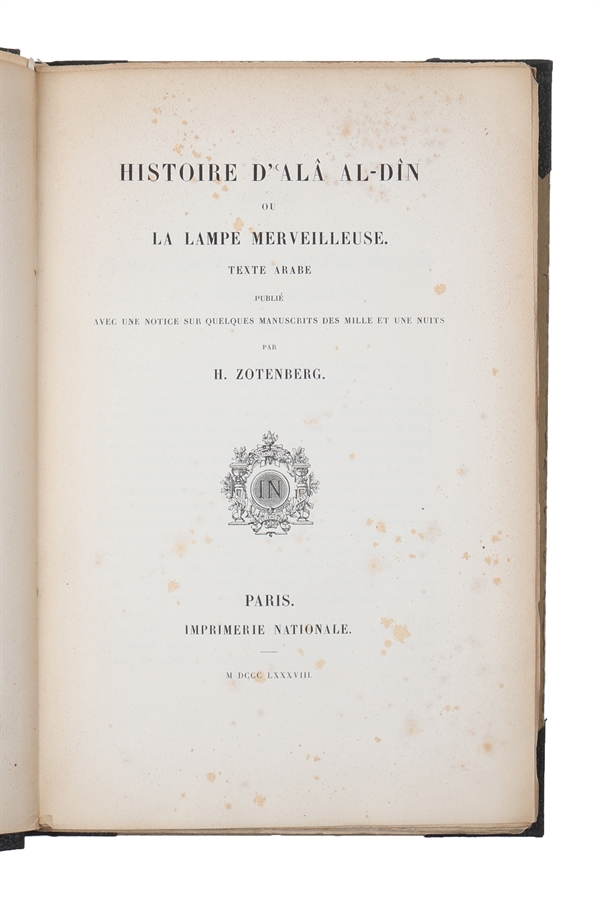
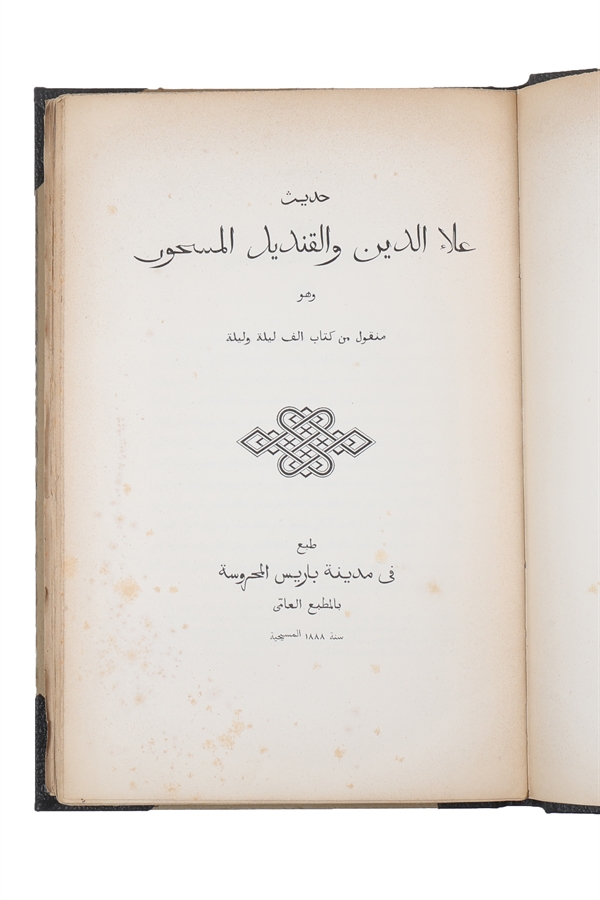
Paris, Imprimerie Nationale, 1888.
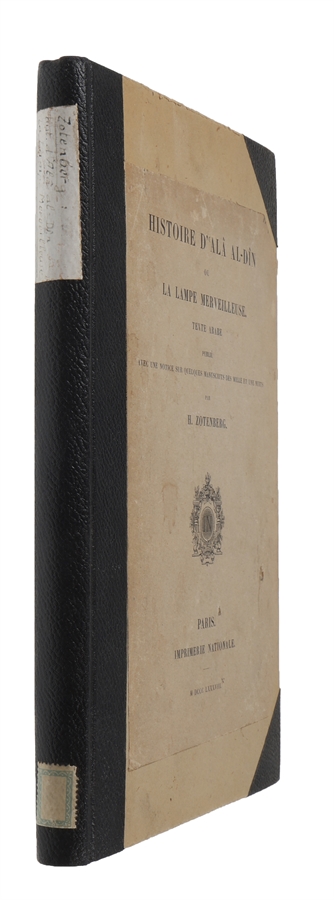
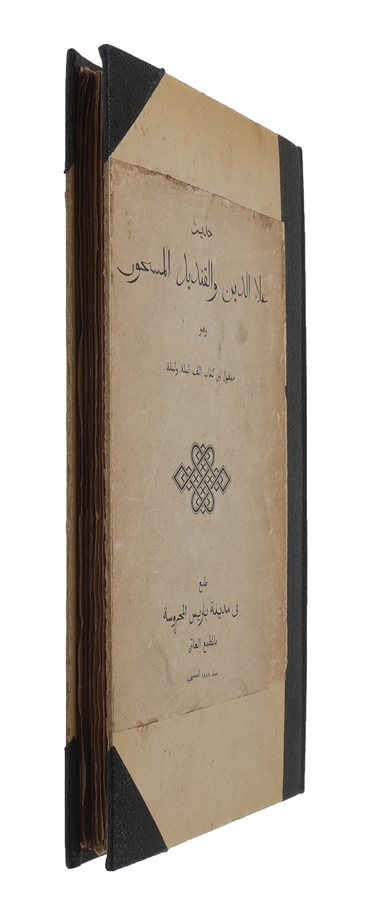
Large 8vo. (185 x 276 mm). Uncut in a recent black half cloth with paper covered boards (same colour as the original wrappers) with the original wrappers (blank part to top and bottom cropped, so smaller format, but no loss of imprint) pasted on to front and back board respectively. Paper labels to spine. A bit of spotting and browning to the wrappers. Also internally some brownspotting and a few pencil underlinings in the text (a couple in red crayon). A few marginal pencil annotations in the Arabic text. (4), 70 (French text); (4), 86 (with Arabic numbering) pp.
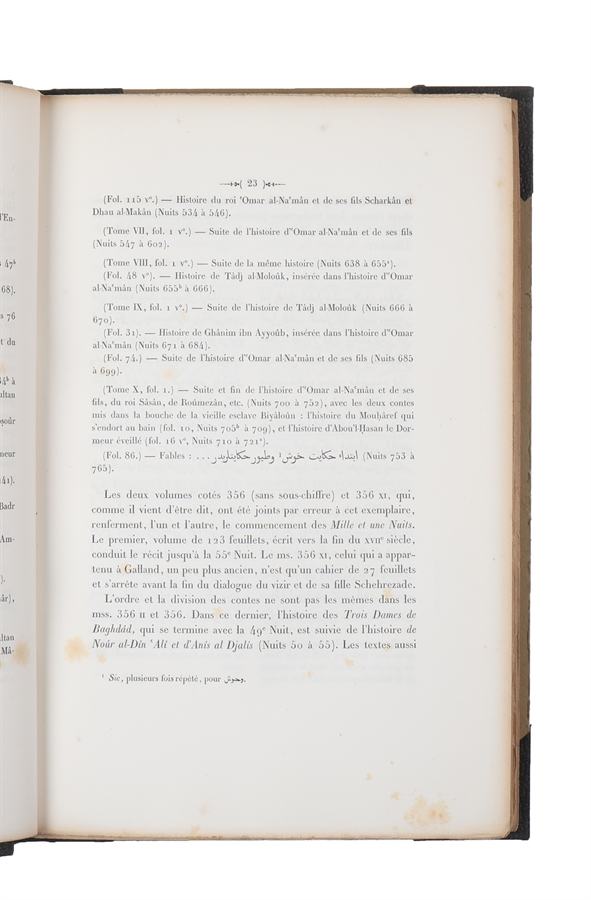
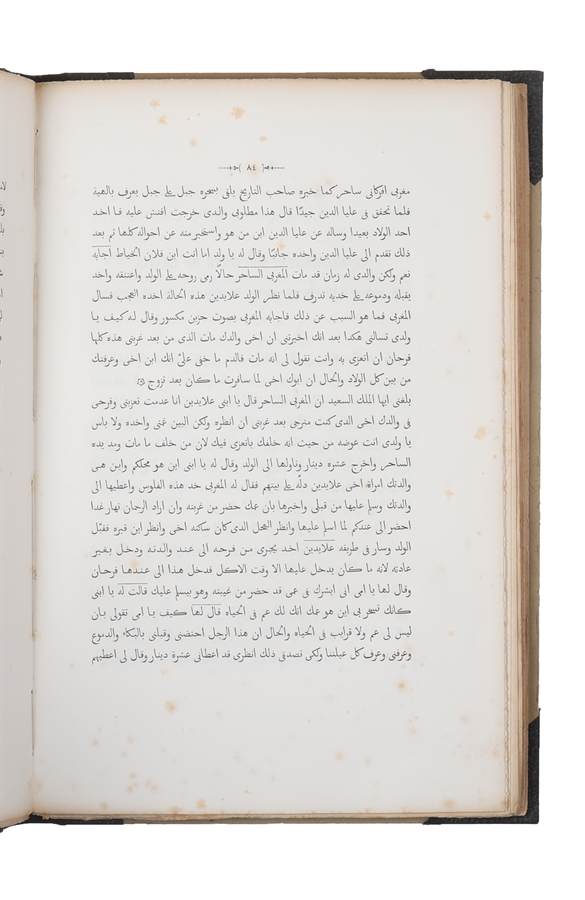
Very rare first edition of the first individual printing of Aladdin in Arabic, published by French orientalist and Arabist H. Zotenberg (1836-1894). It is now known that Aladdin is an orphan tale – a tale with no known textual origins. It was first incorporated in One thousand and one nights in the first European translation by the French orientalist and archaeologist Antoine Galland (1646-1715). Galland’s main text source was a three-volume Syrian manuscript - also known as the Galland manuscript – which is broadly estimated to 1350-1450 and is considered the earliest extensive manuscript of the Thousand and One Nights. Galland’s translation comprises 12 volumes (1704-1717), of which some contain stories from oral and other sources, Aladdin being one of them. His translation remained standard until the mid-19th century, and parts were even retranslated into Arabic. Over a century later, while working as a manuscript curator at the French national library, the Arabist scholar Herman Zotenberg (1836-1894) came across Galland’s archived diaries. There it was noted that Galland’s source for Aladdin or The story of the lamp was Hanna Diyab, in 1709. Zotenberg thus claims to have published for the first time the Arabic version of the story, based on two manuscripts, both from learned men employed at the Royal Library in Paris: one from 1787 in the hand of a Syrian Christian priest, Dom Denis Chaves; the other, from 1805-8 by Michel ?abbagh. The latter claimed to be a copy of a manuscript written in Baghdad in 1703. However, researchers have suggested that both manuscripts were back-translations of Galland’s French version (see Irwin 2005). Zotenberg writes the following in his note to the Arabic text: “The text printed below [e.g. the Arabic text] is found in folios 94 vo to 147 in the manuscript of the National Library, Arabic Supplement 2523, copied by Michel Sabbagh, and covers nights 514 to 591 […]. In this edition, these incipits and explicits have not been reproduced.” (p. 69) “The tale of The Wonderful Lamp, as we possess it, is modern. It presents a fairly faithful picture of the customs of Egypt under the reign of the last Mamluk Sultans […]. Perhaps, even, its composition does not date back that far [-1517]. Moreover, it is less the subject of the story that charms the reader or listener than the way in which it is developed. In this respect, the tale of The Wonderful Lamp is a literary work of undeniable merit. Its lasting success is due to the talent of the Arab novelist and, in part, also to that of Galland […].” (p. 70) It is noteworthy that the first printed edition of One Thousand and One Nights in Arabic was published in 1775. However, no copy is known to have survived, although it was the basis for a later edition from 1835, possibly the first Arabic version published by a non-European. Further reading: Irwin, Robert (2005). The Arabian Nights. A Companion. London: I. B. Tauris & Co. Razzaque, Arafat A. (2017, September 14). Who “wrote” Aladdin? The Forgotten Syrian Storyteller. Encycl. Britt.: "The Thousand and One Nights".
Order-nr.: 63250