

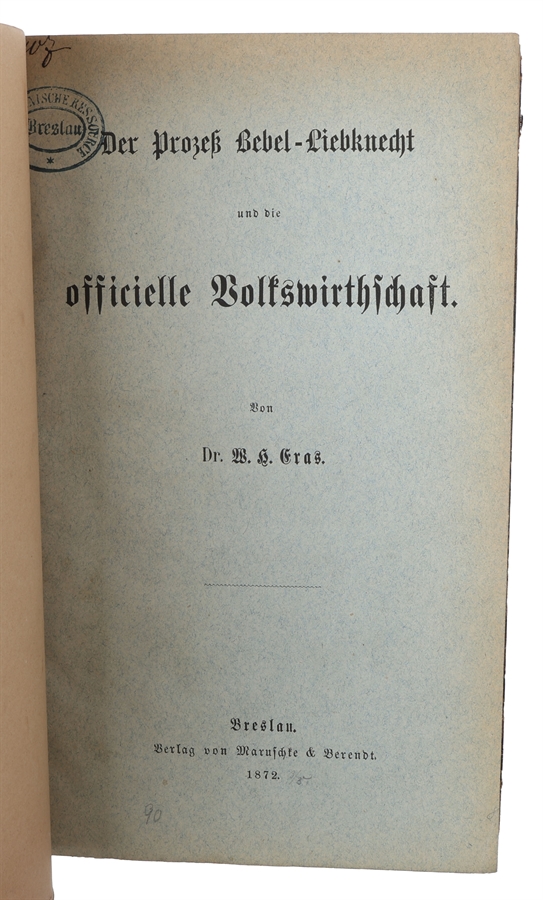
Breslau, Verlag von Maruschke & Berendt, 1872.
8vo. Bound with the original printed wrappers in contemporary half calf cloth. Paper-label to upper part of spine. Inner front hinge split. Stamp to front wrapper and verso of title-page, otherwise internally nice and clean. III, (2), 4-32 pp.
First edition of this contemporary political commentary on the famous 1872 Leipzig high-treason trial of August Bebel and Wilhelm Liebknecht. The trial, arising from their opposition to the Franco-Prussian War and expressions of sympathy with the Paris Commune, became a defining moment in the formation of the German socialist movement and preceded the Anti-Socialist legislation of the later 1870ies. “In the autumn of 1870, public opposition to the war against France was voiced in the Reichstag by August Bebel (1840–1913) and Wilhelm Liebknecht (1826–1900). Bebel would later go on to express support for the Paris Commune in a speech to the Reichstag on May 25, 1871. As a result, these two Social Democratic leaders—together with Adolf Hepner (1846–1923), an assistant at the Socialist Volksstaat—were tried before the Court of Assizes in Leipzig from March 11–26, 1872. The formal charge against the trio was that they had made “preparations for high treason.” Actually, their speeches and the fledgling party they represented threatened neither Bismarck’s policy nor public peace at that time. But their sin was to have linked opposition to Germany’s annexation of Alsace and Lorraine with support for the struggle of the Communards in Paris: that linkage greatly increased workers’ respect for these Social Democratic parliamentarians while damning them, in the eyes of most middle- and upper-class Germans, as dangerous revolutionaries who endorsed terror and the wanton destruction of property. This two-week trial was relatively long by the standards of the day, and the prosecution was forced to make its case mainly by citing allegedly treasonous phrases from the writings of the two principal defendants (the case against Hepner was abandoned along the way). Both aspects only heightened the trial’s political impact, as did the court’s decision—unwarranted on constitutional grounds—to strip Bebel of his Reichstag mandate (he later won a by-election). On March 26, 1872, Bebel and Liebknecht were each sentenced to a two-year prison term under “honorable custody” in the Hubertusburg Castle in Saxony. On July 8, 1872, Bebel entered prison, where he joined Liebknecht, who was already incarcerated. “ (Forging an Empire: Bismarckian Germany (1866-1890) Politics II: Parties and Political Mobilization Source (14/121))
Wilhelm Liebknecht, German socialist and one of the principal founders of the Social Democratic Party of Germany, used his newspaper to agitate against the Franco-Prussian War, calling on working men on both sides of the border to unite in overthrowing the ruling class. As a result, he and Bebel were arrested and charged with treason and in 1872, both Liebknecht and Bebel were convicted and sentenced to two years of Festungshaft ("imprisonment in a fortress").
Order-nr.: 62980