
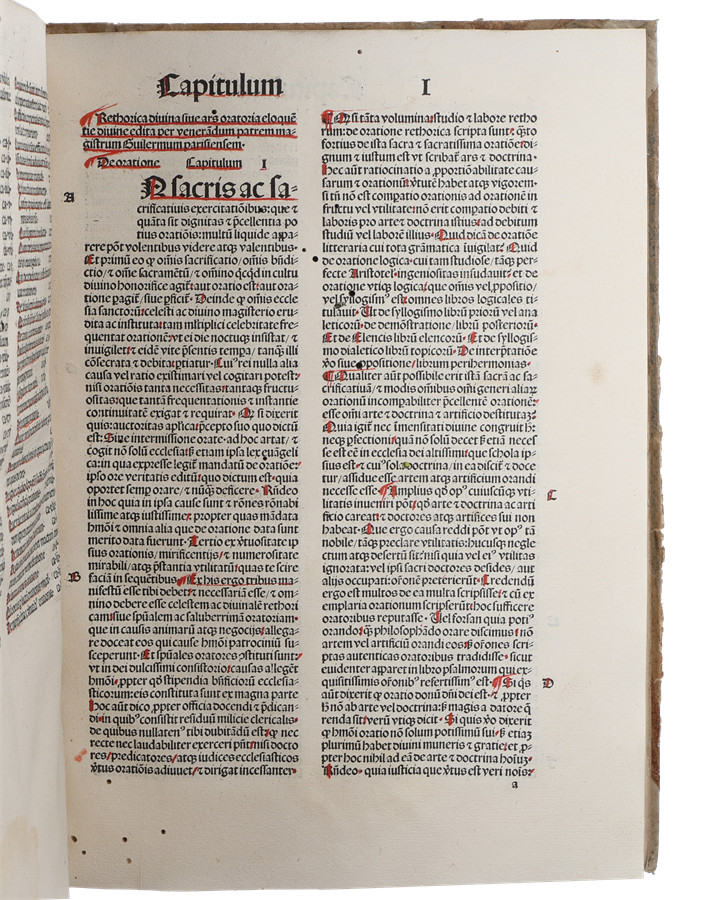
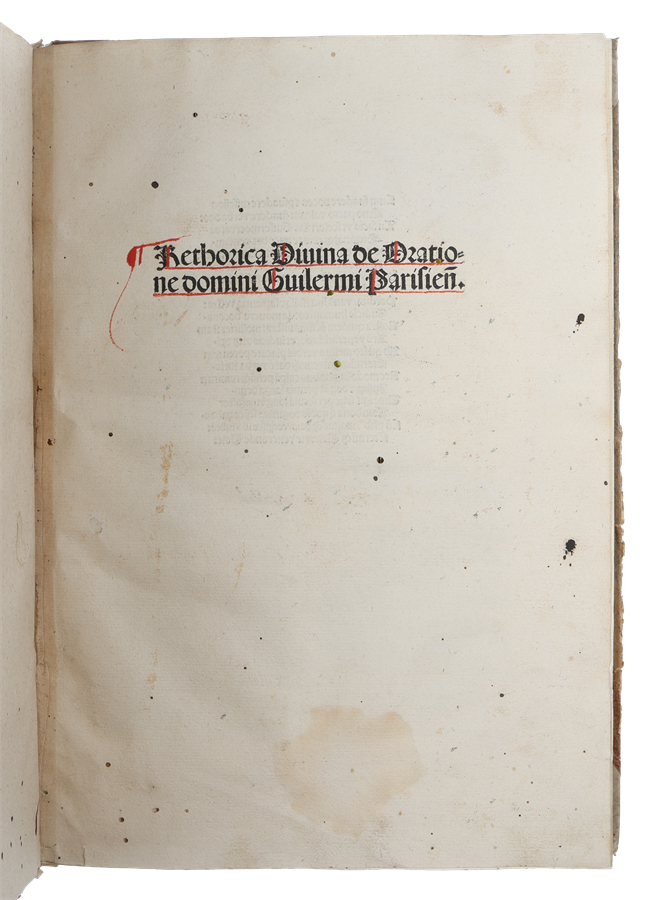
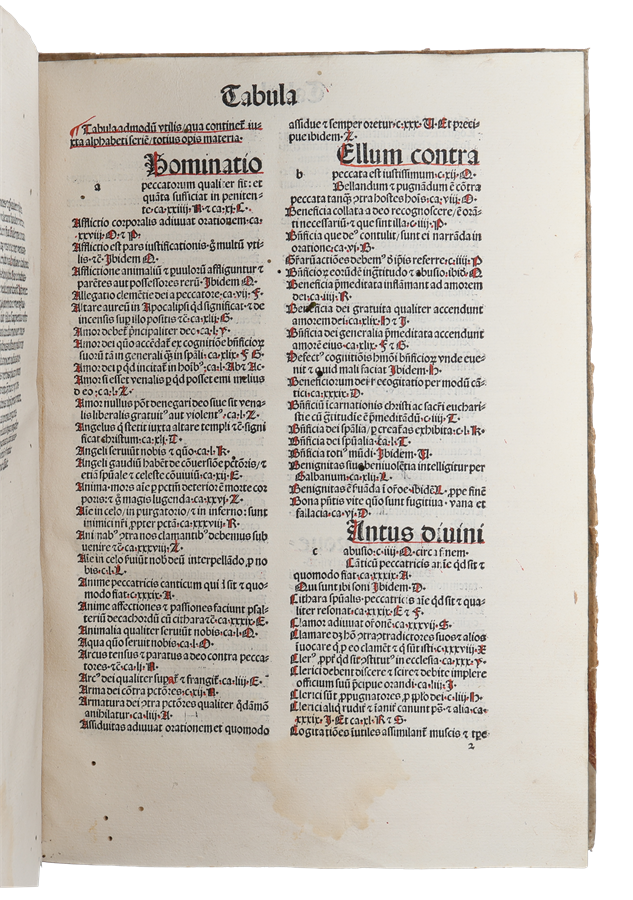
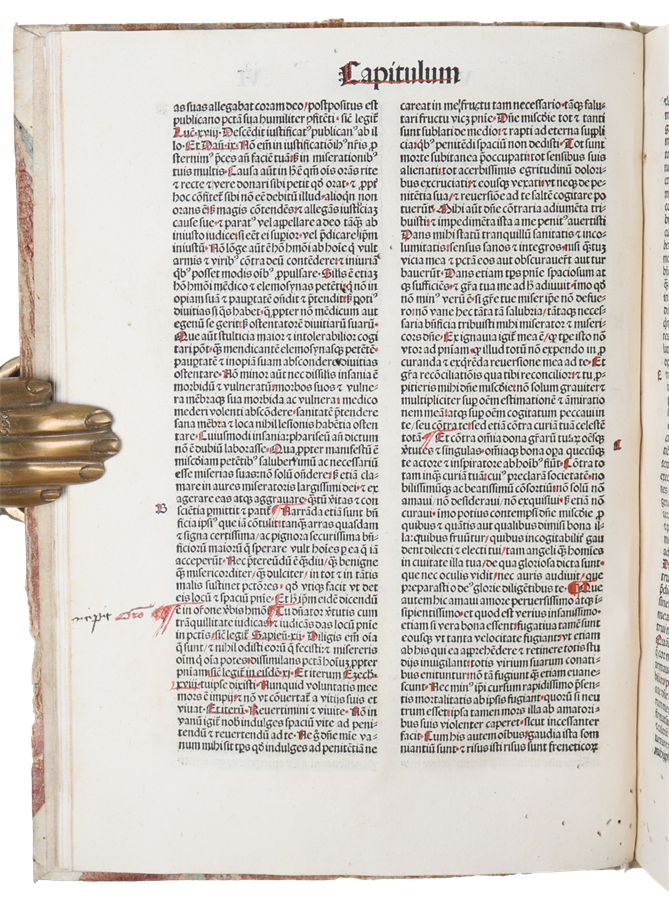
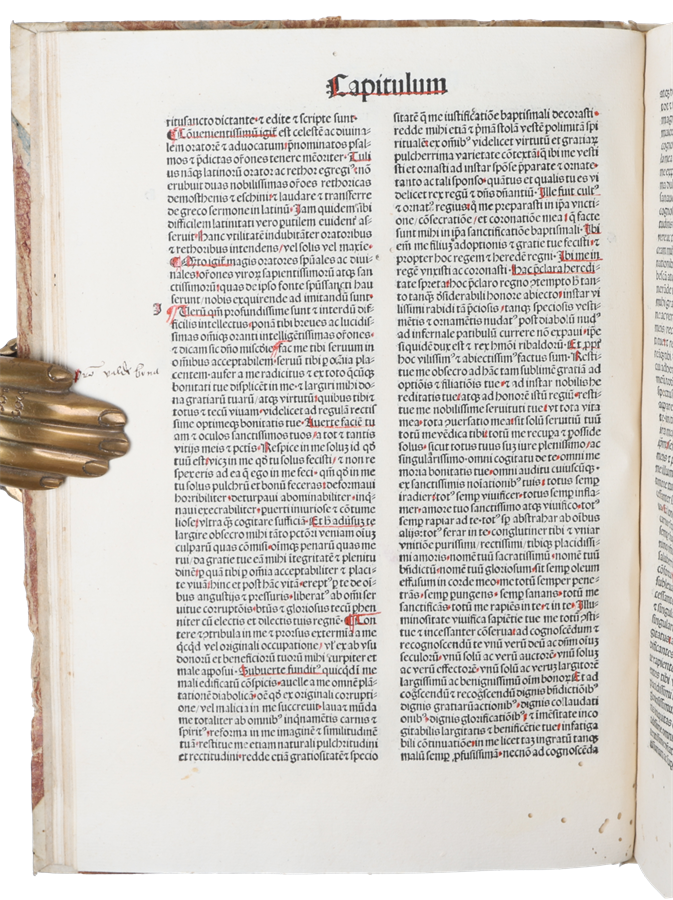
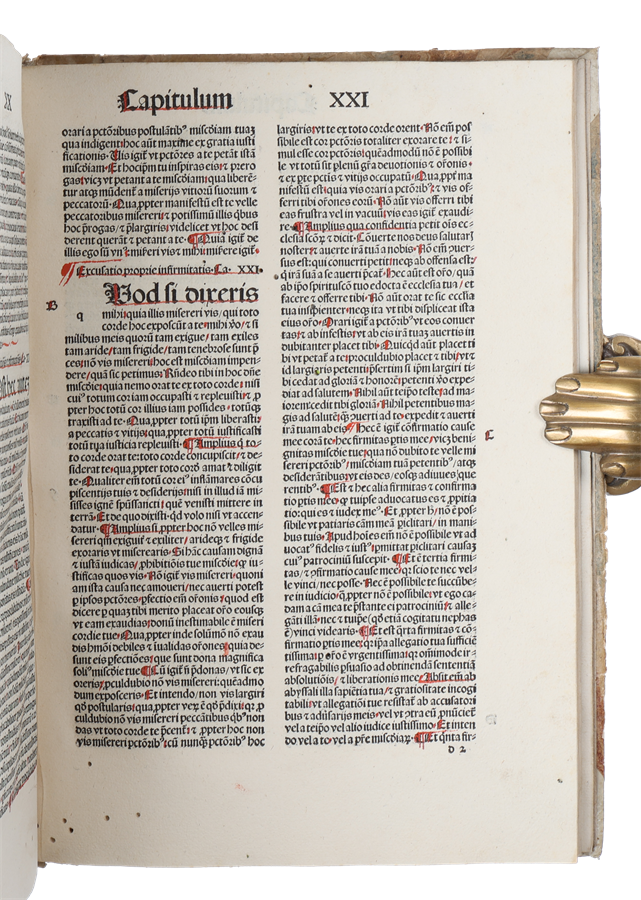
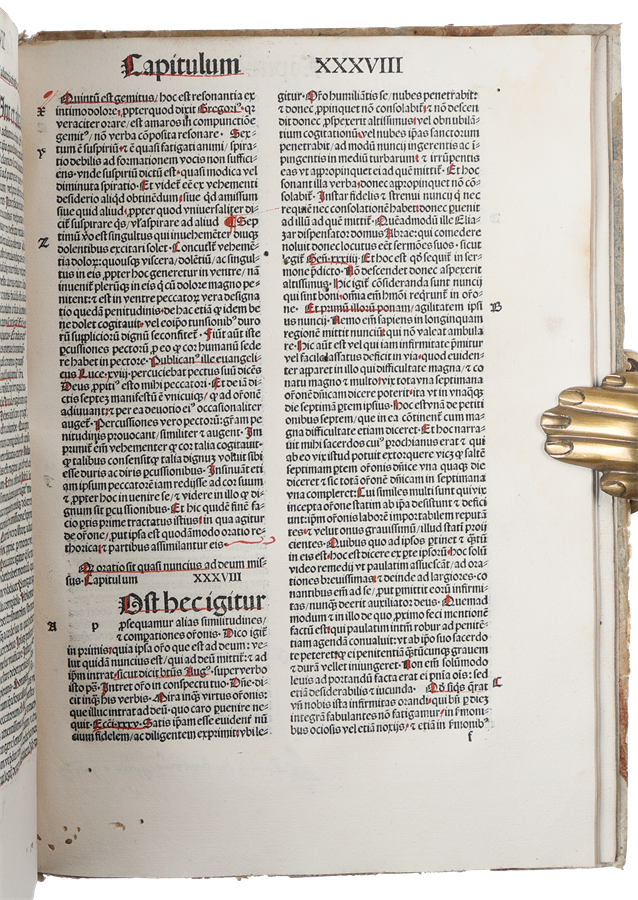
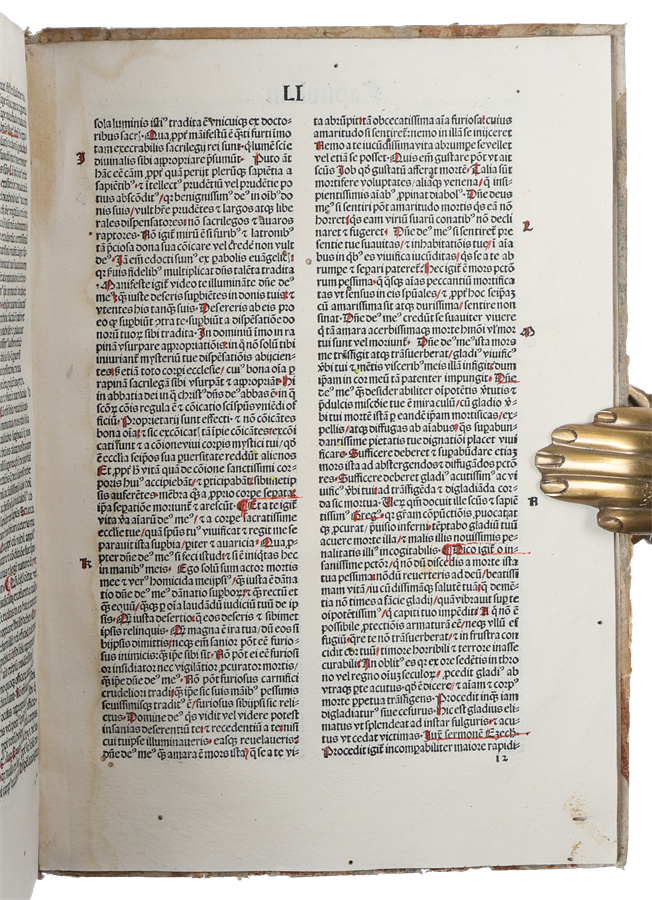
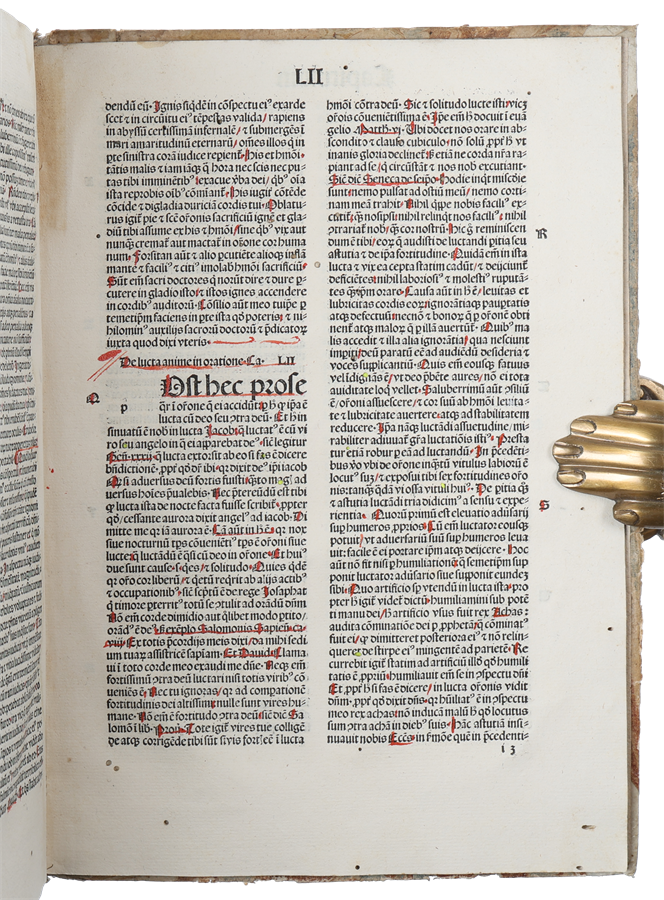
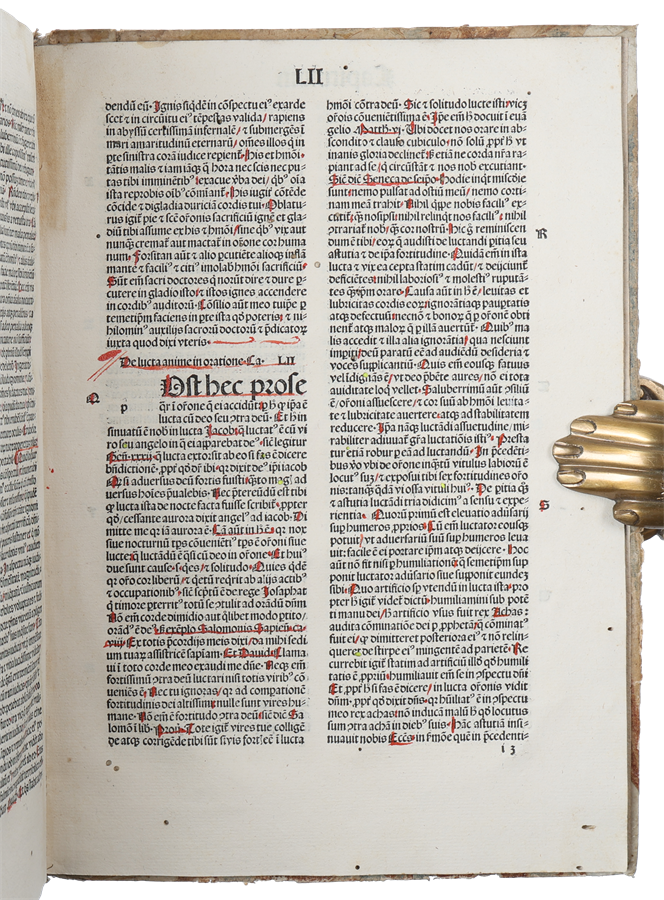
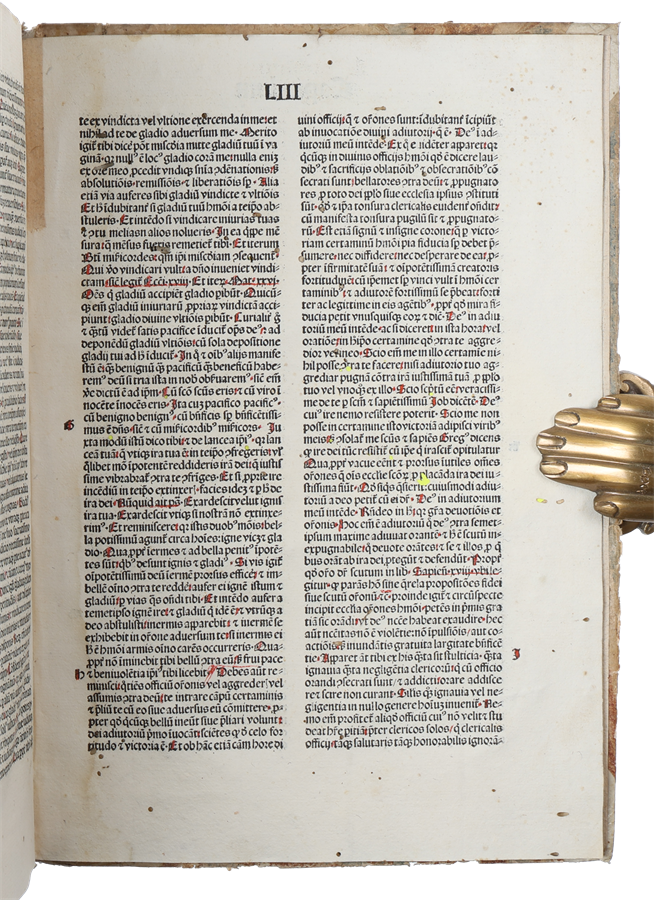
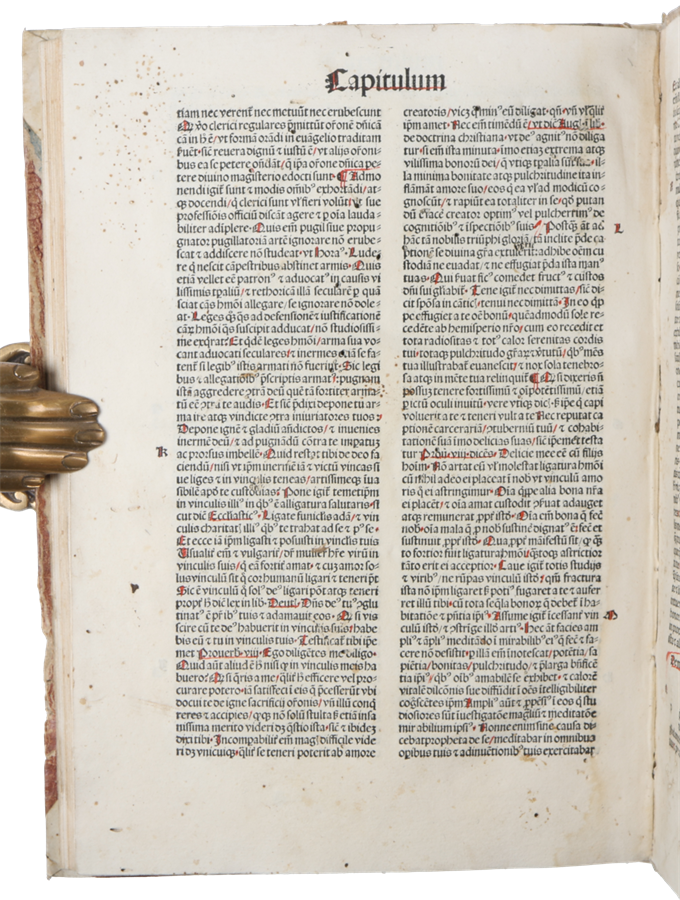
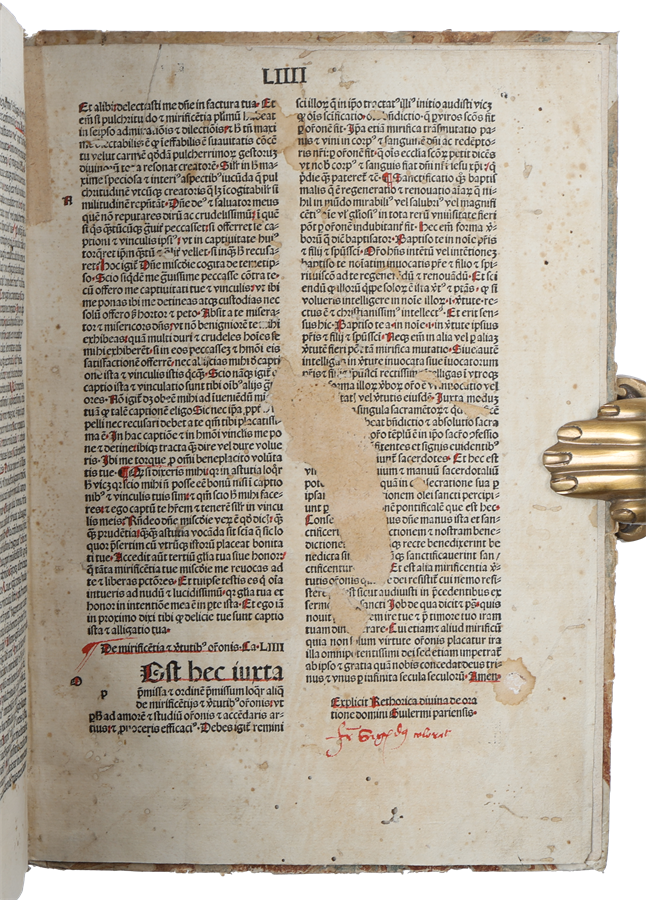
(Freiburg, Kilian Fischer, ca. 1490/1491).
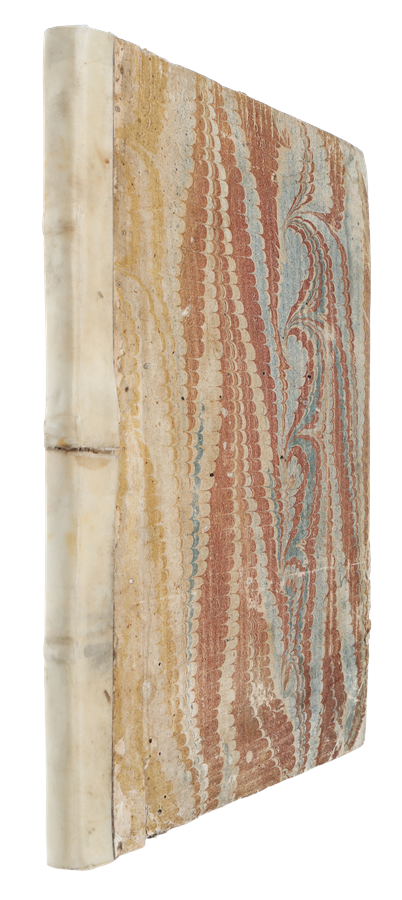
Small folio. Bound (presumably in the 18th century) in later marbled boards with a vellum spine. Binding with wear, edges of baords worn, smaller wormholes, and overall wear. The spine seems to be make up of two peices of vellum, with a small gap where they meet at the middle of the spine. The small wormholes go through the block, causing tiny loss of parts of lettering here and there. The final leaf lacking a larger piece causing partial loss of text to ca. 20 lines. The leaf is mounted from verso. First eight leaves with a damp stain to lower margin and first and last leaves with some soiling and staining. Otehwise, the block is overall clean and fresh.
(58) ff. 52 lines and headline, double columns. Three-and four-line initial spaces with printed guide-letters. Initials touched in red throughout and red underlinings and markings.
Scarce first edition thus, being the second edition (following the 1483-edition printed in Gand) of William of Paris’ highly important work on the art of prayer and the first book printed in Freiburg. There has always been consensus about the book being printed around 1490, no later than 1491, but the printing place of the book has previously been contested. Earlier bibliographies (Eg. Hain, Grasse) state that it was printed in Basel by Johannes Amerbach, but it has later been proven (after the thesis of BMC) to have been printed by Kilian Fischer in Freiburg im Breisgau and is now considered the first book printed there. The scholastic philosopher Guillaume d’Auvergne (ca. 1180 - 1249), also known under the names Guillermus Episcopus Parisiensis, Wilhelm von Auvergne, William of Paris etc., was the most prominent French philosopher-theologian of the early 13th century and one of the first Western scholars to attempt to integrate Classical Greek and Arabic philosophy with Christian doctrine. He was also a first mover in creating a new metaphysics that combines Neoplatonism with empiricism and ontology, profoundly changing the face of medieval philosophy from the 13th century. “William of Auvergne or Paris, (ca.1180/90–1249), Bishop of Paris from 1228 until his death in 1249, was one of the first wave of thinkers in the Latin West to engage with the writings on natural philosophy and metaphysics by Greek, Islamic and Jewish thinkers that had recently become available in Latin translation. William took these writings to pose errors dangerous to the Christian faith, and his philosophical works are in large part aimed at combating their errors. Yet at the same time he recognized their philosophical value and, though often confused about their meaning, incorporated their teachings into his own thought. On many of the important issues of later medieval thought, William is the first to provide in-depth discussions, and his voluminous works are an important and still under-appreciated source for our understanding of the development of medieval philosophy.” (Stanford Encycl. of Philosophy). “By the third decade of the thirteenth century there emerge the first signs of a new metaphysics. Alongside Neoplatonizing idealism we now see attempts to lay greater emphasis on the ontological density of the created world and to structure reality without resorting to the terms of a relation to the divine ideal… The two figures who did the most to promote the new metaphysics, as well as a profoundly Aristotelianizing campaign to establish the criteria for knowledge, were masters whose important work was done between 1220 and 1235 in the chools of theology at the new universities. Robert Grosseteste (d. 1253)… [and] William of Auvergne (d. 1249).” (John Marenbon, Medieval Philosophy, 1998, vol III, p. 204). Making extensive use of Avicenna and Aristotle as they were just becoming known through translations, in order to understand Christian faith and philosophy, William as a bishop also had concerns that reflected the practical use of his teachings. The present work, “Divine Rhetoric” is his instructive magnum opus. Here, he seeks to explain and illustrate the art of prayer – or divine eloquence -, listing seven characteristics and perfections of prayer. The work is equally famous for its application of Ciceronian rules of oratory to Christian oratory and prayer. For more on the Freiburger printer Kilian Fischer, please see Hermann Baumeister’s “Der Freiburger Buchdruck in der Inkunabelzeit (“Kilian Fischer Als „vermutlich erster Freiburger Druck' erscheint „nicht nach 1491 " aus der Offizin Kilian Fischers eine Predigtsammlung sechs ausgewählter Predigten von Ephrem dem Syrer (303- 373) in lateinischer Sprache, die Kilian Fischer zusammen mit der „Rhetorica Divina” des Pariser Bischofs Guillelmus Alvemus herausgab.” (p. 104); “Die Drucke Kilian Fischers sind reine Werkdrucke. Er verwendete drei verschiedene Grundchriften; ohne verzierende Initialen oder Abbildungen. Die entsprach auch dem rein wissenschaftlichen Charakter der Lehrbücher seiner Produktion.” (p.107). ) Hain: 8303, Graesse: III:183; BMC III:693; GW: 11866.
Order-nr.: 62907