
![Markens Grøde. To Dele. [I.e. Growth of the Soil. Two Parts].](/images/fancy/62854b.jpg)
![Markens Grøde. To Dele. [I.e. Growth of the Soil. Two Parts].](/images/fancy/62854c.jpg)
![Markens Grøde. To Dele. [I.e. Growth of the Soil. Two Parts].](/images/fancy/62854e.jpg)
![Markens Grøde. To Dele. [I.e. Growth of the Soil. Two Parts].](/images/fancy/62854f.jpg)
![Markens Grøde. To Dele. [I.e. Growth of the Soil. Two Parts].](/images/fancy/62854a.jpg)
Kristiania (i.e. Oslo), 1921.
Both parts bound with the the original front wrappers in one contemporary brown half calf with raised bands and gilt lettering to spine. Binding solid and sturdy, but spine with some wear.A bit of light spotting to wrappers and a few scattered brown spots, but overall very nice and clean.
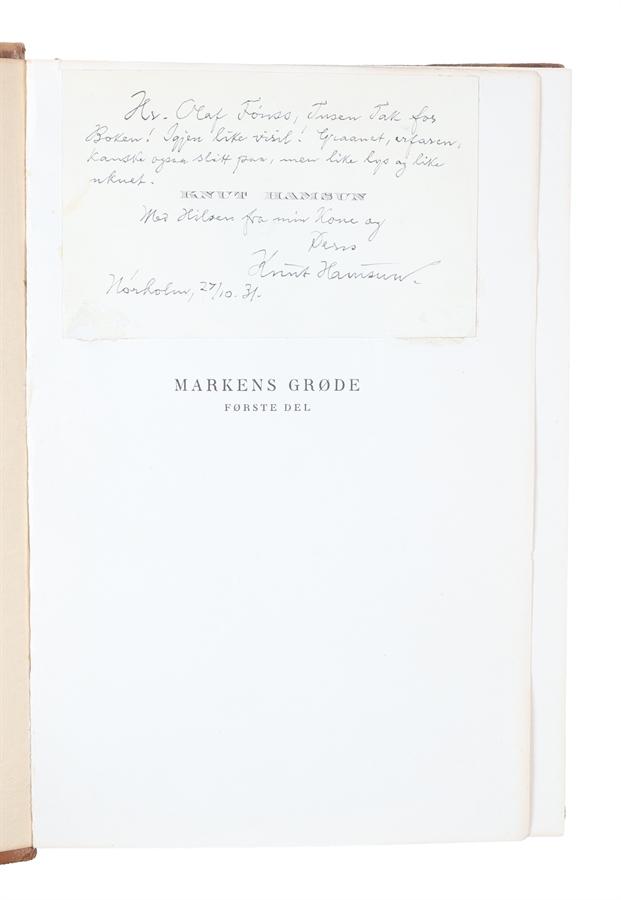
Inserted onto the half-title of vol. one is an original visiting card from Hamsun, imprinted "KNUT HAMSUN", with a seven-line handwritten and signed inscription in Knut Hamsun's hand, for Olaf Fønss, dated "Nørholm, 27/10. 31.".
Olaf Fønss' exlibris to inside of front board.
A magnificent copy of the 1921-edition (printed shortly after he won the Nobel Prize) of Hamsun’s mature magnum opus “Growth of the Soil” - one of the greatest classics of the 20th century and the work that earned Hamsun the Nobel Prize (1920) - the great actor Olaf Fønss’ copy, with a handwritten visiting card from Hamsun to Olaf Fønns. The handwritten text (in Norwegian) on the card reads “Hr. Olaf Fønss, Tusen Tak for / Boken! Igjen like viril! Graanet, erfaren, / kanske ogsaa slitt paa, men like lys og like / ukuet. / Med Hilsen fra min Kone og / Deres / Knut Hamsun. / Nørholm, 27/10 31.” (I.e. Mr. Olaf Fønss / a thousand thank yous / for the book! Again, just as virile! Greying, experienced, / perhaps also worn, but just as bright and just as / indomitable / With greetings from my wife and / your / Knut Hamsun / Nørholm, 27/10. 31.” Olaf Holger Axel Fønss (1882-1949) was one of the greatest actors of the era, one of the biggest silent film stars of Denmark and Germany. Apart from being an actor and a top matinee idol, he was also a writer, director, producer, and film censor. Although we have not been able to determine it for sure, it is very likely that Fønns will have played Hamsun characters on the stage at some point, perhaps also Isak Sellenrå, the main character of “Growth of the Soils”. At least, the present copy of the work would suggest so. “Growth of the Soil” is one of the greatest novels of the 20th century, and it profoundly shaped the way of modern literature. It is widely regarded as one of the best books of the 20th century. Thomas Mann called it ”a wonderful, extraordinary book”; Heminway wrote about the book, from Switzerland, to Fitzgerald in Paris, recommending him to read is, as it was so good; André Gide (as many others before and after) compared Hamsun to Dostojevsky, but commented that he was more refined; Singer was hypnotized by him; Knausgård considers the work hypnotizing; Kafka was utterly fascinated, H.G. Wells was thoroughly impressed and called it one of the best novels he had ever read, describing it as beautiful through and through, etc., etc. “One of the most important and controversial writers of the 20th century... Hamsun influenced many of the major 20th-century writers who followed him, including Kafka, Joyce and Henry Miller." (George Egerton). Hamsun is considered "one of the most influential and innovative literary stylists of the past hundred years" (i.e. 1890–1990) (Robert Ferguson). He pioneered psychological literature with techniques of stream of consciousness and interior monologue, and influenced authors such as Thomas Mann, Franz Kafka, Maxim Gorky, Stefan Zweig, Henry Miller, Hermann Hesse, John Fante, James Kelman, Charles Bukowski, and Ernest Hemingway. Isaac Bashevis Singer called Hamsun "the father of the modern school of literature in his every aspect—his subjectiveness, his fragmentariness, his use of flashbacks, his lyricism. The whole modern school of fiction in the twentieth century stems from Hamsun". “When it was first published in 1917, Growth of the Soil was immediately recognized as a masterpiece. Ninety years later it remains a transporting literary experience. In the story of Isak, who leaves his village to clear a homestead and raise a family amid the untilled tracts of the Norwegian back country, Knut Hamsun evokes the elemental bond between humans and the land... Hamsun’s novel is a work of preternatural calm, stern beauty, and biblical power—and the crowning achievement of one of the greatest writers of the twentieth century.” (Penguin Classics).
Order-nr.: 62854