
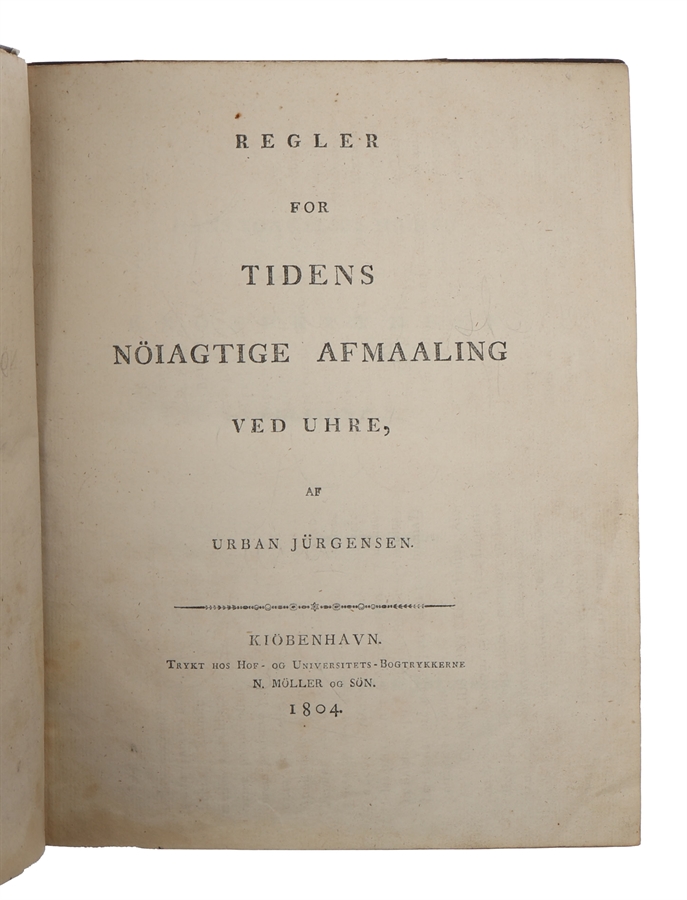
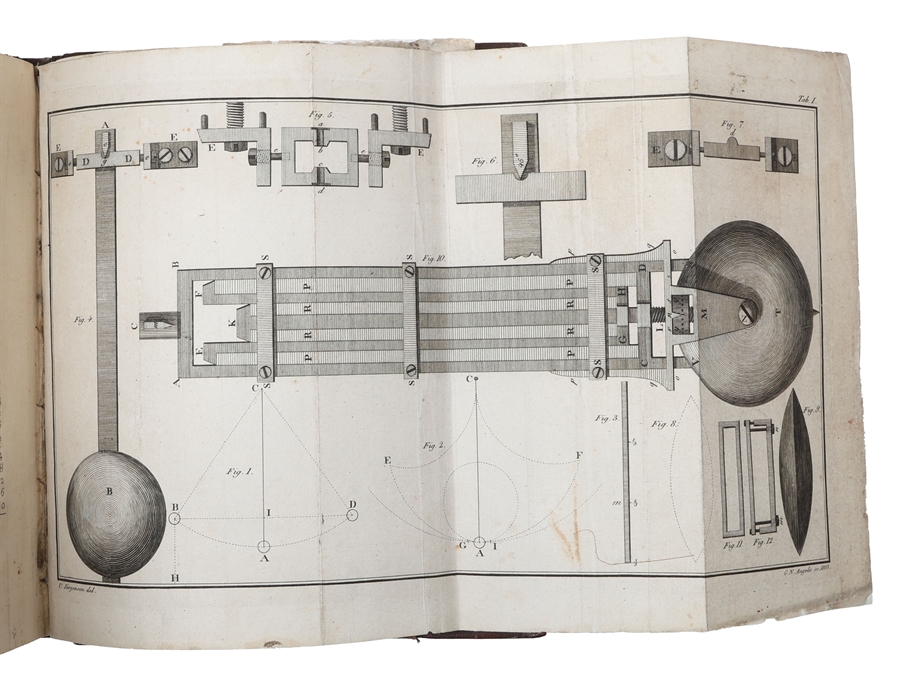
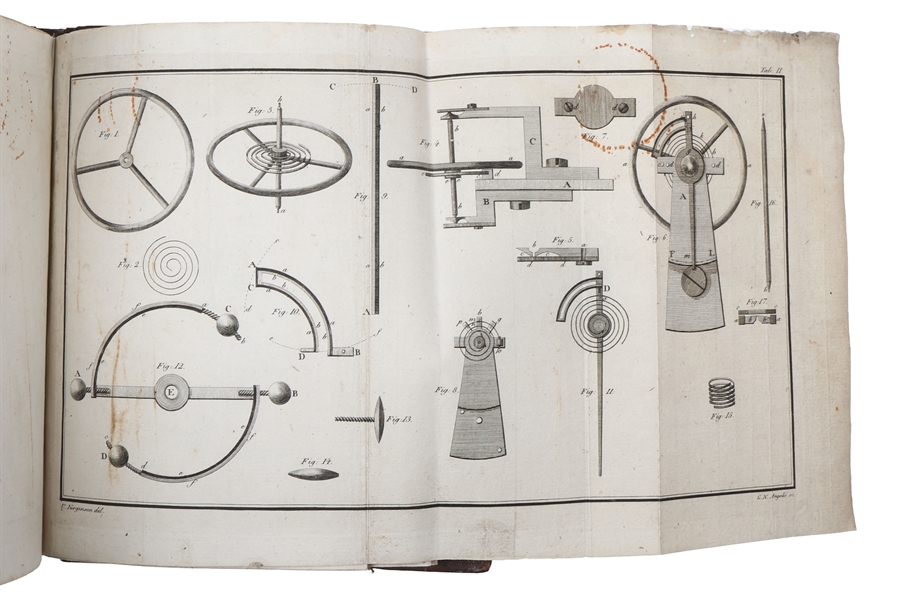
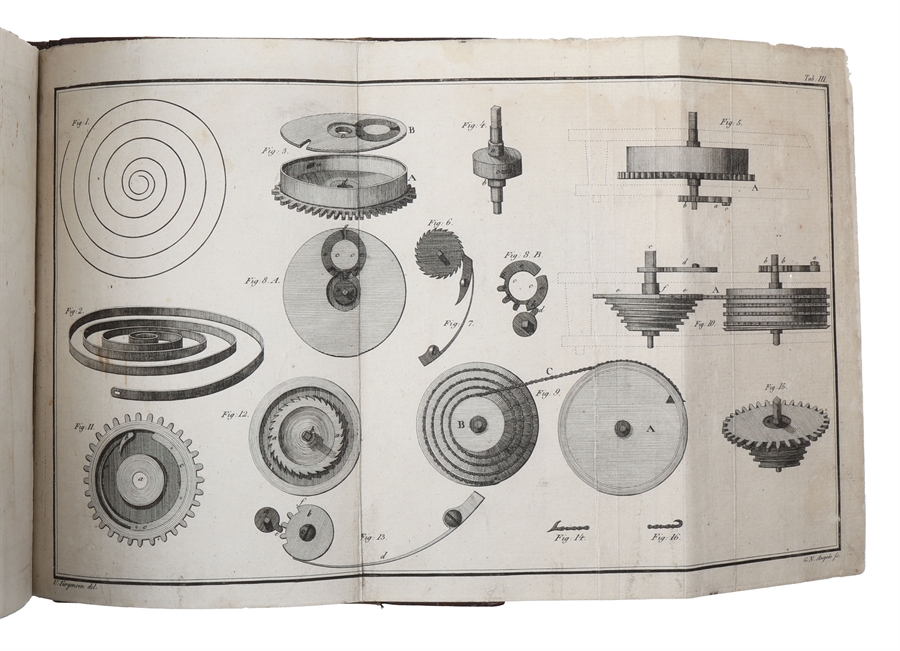
Kiöbenhavn, N. Möller og Sön, 1804.
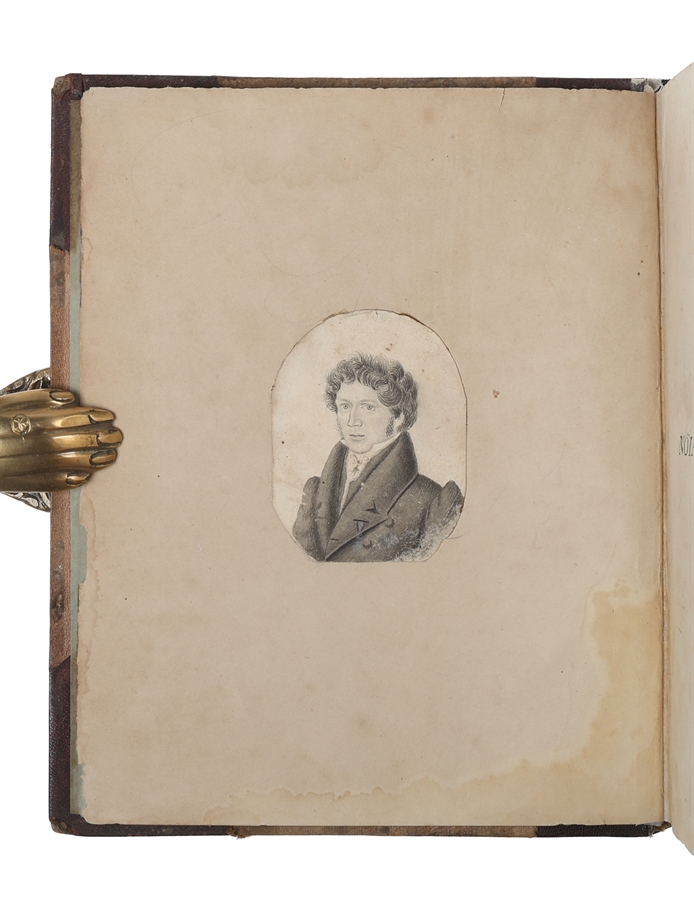
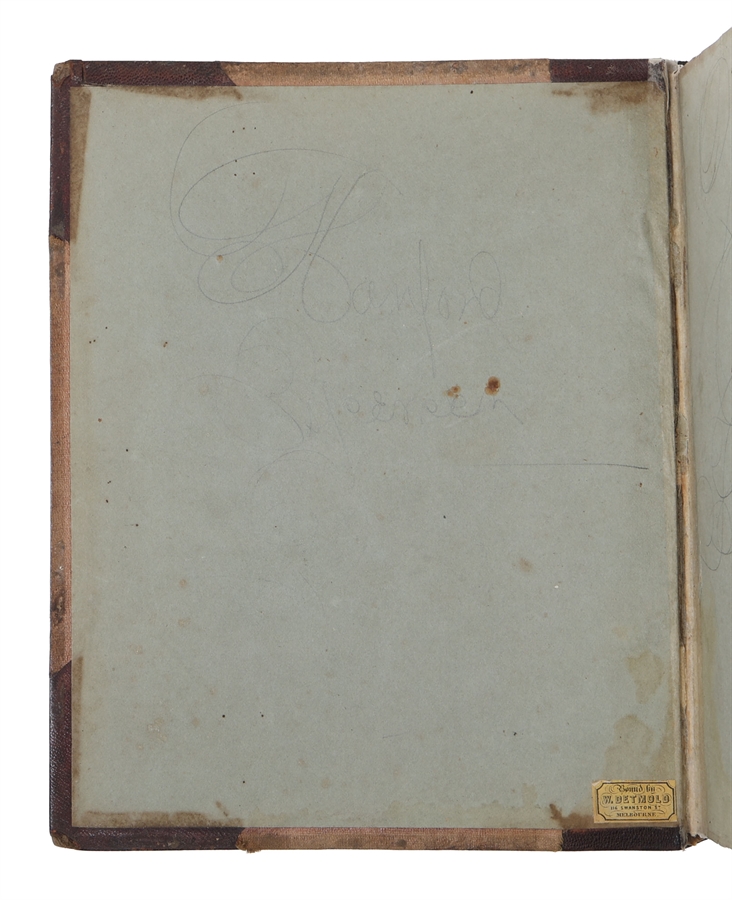
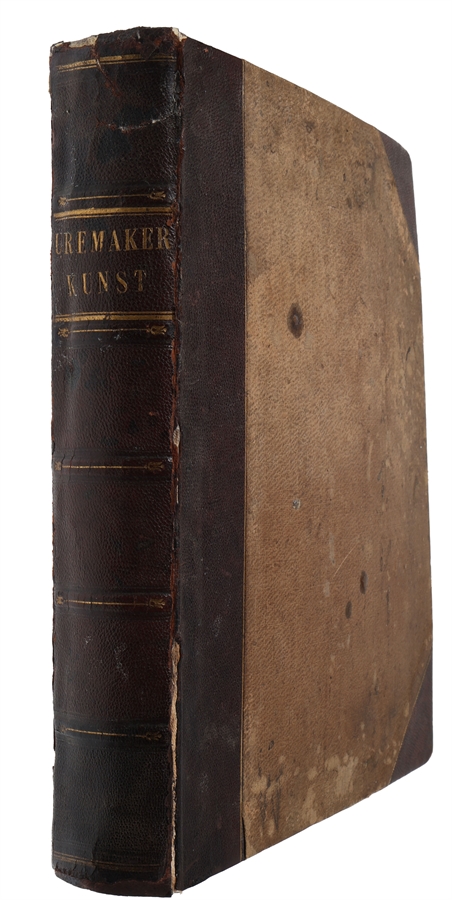
4to. Near contemporary brown half calf with cloth-covered boards gilt title to spine (UREMAKER KUNST), with Australian bookbinder's etiquette: "W. Detmold, Melbourne" to inside of front board. Pencil name and doodles to front end-papers and traces of the same kind of pencil-names and doodling to the first leaves, removed. Front free end-paper with a portrait inserted (possibly of Urban Jürgensen, possibly of his brother Jøregen Jørgensen - see below under Provenance). Hinges and capitals worn. Hinges professionally re-enforced from verso and restorations to capitals. Text overall nice and clean, with the occasinal browning or dampstaining. Plates have some overall toning/even soiling and staining and some occasional offsetting or spotting. They have been lightly, and very professionally, cleaned, and a few of them have edge restorations (far from affecting image) or a small re-enfircement from verso, barely noticeable. Bothe text and plates printed on thick, heavy paper. XXVI,242 pp. and 18 double-page folded engraved plates.
Exceedingly scarce first edition of the first Danish book on watchmaking, constituting a magnum opus of modern watchmaking. After having trained abroad, in Le Locle, Paris, and London, Urban Jürgensen was one of the best-trained watchmakers in the world by the time he returned to Copenhagen in 1801. Not only did he master to perfection the finest techniques of the age, he also improved upon them and experimented with various technologies. His great treatise from 1804, Rules for the Accurate Measurement of Time by Watches and Clocks, is arguably the most important treatise on watchmaking from this period; it was used as a manual for watchmakers all over Europe and is still in use today. The first edition is of the utmost scarcity, with very few copies known on private hands and only a handful of copies in libraries worldwide. The work was quickly translated into French, and a second edition of the Danish translation appeared in 1839. “The story starts with Jørgen Jürgensen, an early Danish watchmaker, in 1773. To give a sense of what Danish watchmaking looked like in the late 1700s, around 20 craftsmen were registered to the trade in Copenhagen. Before Jørgen received Royal support for his business in 1781, the majority of watches in Denmark were imported and of low quality. He successfully made the case over many years that with the government's support, he could create a true domestic industry. As a result, Jørgen can be described as the father of Danish watchmaking. He trained apprentices and was given the right to run a manufacturer. This right was even extended to his sons... "if they possessed the necessary competence for the task." Jørgen's eldest son, Urban Jürgensen, proved to possess more than the necessary competence. Born in 1776, Urban was incredibly intelligent, leaving Copenhagen at the age of 21 after Jørgen decided he had learned all that he could in his home country. His travels brought him to Le Locle, studying under Jacques-Frédéric Houriet; to Paris, to learn from Abraham-Louis Breguet and Ferdinand Berthoud; and then to London, apprenticing for John Arnold and John Brockbank. Urban Jürgensen was one of the best-trained watchmakers in the world by the time he returned to Copenhagen in 1801 – and he backed it up. Before his death in 1830, he produced over 700 watches, including 45 marine chronometers. Urban experimented with various escapement technologies he had encountered during his travels, working with various ébauches, but he certainly preferred the chronometer or detent escapement. He even improved upon the work of Thomas Earnshaw and John Arnold in England by developing the detached double-wheel chronometer escapement toward the end of his career. Jørgen established the idea of Danish watchmaking, and Urban ran with it – particularly with an eye for scientific precision and accuracy.” (https://www.hodinkee.com/articles/urban-jurgensen-then-and-now). “In 1773, Danish horologist Jürgen Jürgensen presented his masterpiece, a repeating watch, to the Danish Watchmakers Guild in Copenhagen, Denmark. The culmination of six years of training in Germany and Switzerland, his efforts earned him the title of Master Watchmaker. Three years later, his eldest son Urban was born. Urban’s star would eclipse even that of his talented father, sparking a multigenerational saga that continues to this day. … Urban, born in 1776, set out on an apprenticeship journey — much as his father had before him — at the age of 21. Having already studied horology under his father’s tutelage, he made his way to France and England, where he had the tremendous fortune of studying in the workshops of Abraham-Louis Breguet, Ferdinand Berthoud and John Arnold. Due to his Danish citizenship, Jürgensen was able to navigate the geopolitical waters that would otherwise have stifled the ambition of an Englishman or a Frenchman desiring to work with his fellows across the Channel. (The two countries were archrivals and soon to be engaged in the Napoleonic Wars.). Returning to Copenhagen in 1801, Urban got to work designing marine chronometers, astronomical pendulum clocks, and even a bi-metallic pocket thermometer that functioned better than standard mercury-based models in freezing temperatures. His 1804 treatise Rules for the Accurate Measurement of Time by Watches and Clocks — published at the age of 28 — was the first Danish book on watchmaking and is still in use today. The influence of Breguet, Arnold and Berthoud combined with his Danish sense of design in functional, forward-thinking, beautiful timepieces began to impress in the highest circles: In quick succession, Jürgensen became the official supplier of marine chronometers to the Royal Danish Navy; the first tradesman inducted into the Royal Danish Academy of Sciences; and, in 1824, a Knight of the Order of the Dannebrog.” (https://www.insidehook.com/watches/urban-jurgensen-historical-watchmaker-returns) “Urban Jürgensen is an independent high-end brand known for obsessing over details, creating masterpieces that may appear minimalistic, but hide an execution of subtleties that few ateliers can match. Founded in Copenhagen in 1773 by Jürgen Jürgensen, the company is among the foremost watchmaking dynasties in history. During the 18th and 19th centuries, the Jürgensen family worked with legends like Jacques-Frédéric Houriet, Abraham-Louis Breguet and John Arnold to set standards for fine watchmaking that still apply today. Urban Jürgensen, first son of Jürgen, continued building the family's brand with innovations like a cylinder escape wheel comprised of hardened steel (instead of traditional brass) to greatly reduce wear and increase reliability. His book, Principes Généraux de l'Exacte Mesure du temps par les Horloges [i.e. the present book, French translation], is still a relevant reference for today's watchmakers. Headquartered in Biel/Bienne, Switzerland, the company was for a time under Danish ownership with Soren Petersen (formerly with Nokia) as President and CEO, before being acquired in 2025 by US-based Rosenfield family and a group of investors, with Finnish independent watchmaker Kari Voutilainen serving as Co-CEO and head of watchmaking.” (https://monochrome-watches.com/urban-jurgensen/) On OCLC, we have been able to locate no more than four copies outside of Copenhagen: Paris, London, Stockholm, and Chicago. Provenance: It is curious that a book like the present should end up in Melbourne (where it was bound) in the mid 19th century. The portrait inserted on the front free end-paper may point to an explanation. This portrait bears quite a bit of resemblance with that of Urban Jürgensen printed in the second edition of the work. But it also bears great resemblance with the portrait (by Eckersberg) of his famous brother Jørgen Jørgensen (the Danish version of the name Jürgensen), who spent the lest part of his life in Tasmania. We have not been absle to establish with certainty whether it is Jørgen or Urban himself, but it seems likely that Jørgen will have brought his brother's great treatise with him to Australia, where it will have remained after his death in 1841. Jørgen Jørgensen (1780-1841), also known as “The King of Iceland”, was a famous Danish adventurer, who led a rather remarkable life. “The ‘Viking of Van Diemen’s Land', Jørgen Jørgensen is without a doubt the most colourful and (in)famous Dane to have come to Australia. He was once called one of the most interesting human comets ever recorded in history. In his 61 years of life, he was a sailor, diplomatic agent, convict, self-proclaimed king of Iceland, police officer, gambler, convict, naval captain, writer, explorer and the list goes on.” (Danes in Australia) “Jørgen Jørgensen (later anglicised to Jorgen Jorgenson) was born on 29 March 1780 in Copenhagen as the second son of royal clockmaker Jürgen Jürgensen and wife Anna Leth Bruun, a very well-respected family. After Denmark’s declaration of war against England he was appointed captain on a Danish privateer, the Admiral Juul, and sent out to destroy British warships. However, he was quickly captured, and subsequently taken back to England as a prisoner of war. In London he befriended a merchant, Samuel Phelps, and later went with him on a trading expedition to Iceland, which was ruled by Denmark. His gambling, drinking and ever-mounting debts, however, were getting the better of him, and the final straw was after he was caught pawning off his landlady’s furnishings and bed linen. He was sentenced to 7 years of exile, caught a month later for still remaining in the country, and sentenced to death, which was then commuted to exile for life. During the next three years, he managed to stay in England, even working as an assistant to the surgeon at Newgate Prison. Antagonised by one of Jorgen’s religious publications, the Home Secretary eventually was forced to send him to Van Diemen’s Land. In 1825 he boarded the convict ship Woodman and arrived on 29 April, 1826, some 22 years after he had first sailed through these waters. The island now had a population of 13,000 (of which 6,000 were convicts) with 5,000 living in Hobart. As a reward for his services Jorgen was awarded 100 acres of land. Eventually, Jorgen received his full pardon, and in 1831 he resigned from the police force. A week later, he married an Irish convict, Norah Corbett, who was half his age and an alcoholic. She proved to be the greatest trial of his life and was often seen chasing her husband down the streets of Oatlands. Jorgen wrote several books and contributed regularly to two daily newspapers in Hobart during his last years.” Bookbinder William Detmold was among the earliest and most important bookbinders in Australia. "William Detmold (1828-1884) of Melbourne, who began in 1854, was an important bookbinder. Hannover-born, Detmold is believed to have trained in New York, where he lived from 1846 until 1852." "Binding skills were originally immigrant. Training by apprenticeship, formal or otherwise followed. Trades training away from the workplace began about the beginning of the twentieth century. Examples of the second generation of binders are Charles Harwood, originally a convict, trained by Moffitt, later in business for himself in Sydney for at least twenty years, and the Wrigleys, who arrived in Melbourne as children in the 1850s, worked for Detmold, and for themselves in the 1870s and 1880s. By the second half of the nineteenth century, we find a gradual separation of specialised book trades into freestanding businesses. The emergence was slow and incomplete. The association of binding with related trades makes it difficult to determine who were the BOOK binders. The emphasis of advertisments sometimes provides a clue. John L Sherriff, of Sydney, in The Australian almanac for the year 1874 advertises himself as 'bookseller, stationer and publisher', although stating 'JLS gives his attention to the following branches of business:- Bookselling, publishing, binding, printing, engraving and lithographing, picture framing, account book manufacturing' (p37). In A glance at Australia in 1880 by Mortimer Franklyn (Melbourne, 1881) Maddock advertises himself as, 'importer of books and stationery', listing bookbinding in a long list of services provided. Bookseller George Robertson of Melbourne's new premises were described by the Bookseller in 1872 as having a bindery for the manufacture of account books. Without the ledger trade, in particular, it is dubious if the competence to be found in much nineteenth century Australian binding would have been possible. From stickers we know that Robertson bound books, presumably for customers, and his own publications. Even binders working independently offered services such as the manufacture of account books or fancy boxes. William Detmold (1828-1884) of Melbourne, who began in 1854, was an important bookbinder. Hannover-born, Detmold is believed to have trained in New York, where he lived from 1846 until 1852. As well as Detmold, Tanner's Melbourne directory for 1859. (Melbourne, John Tanner) lists Cook & Fox, E. Esquilant and T.J. Walters. The publication itself, bound in khaki coloured buckram with a blind embossed rectangular cover design, gilt lettering on the front cover and a blank spine, is a publisher's binding with Detmold's sticker on the endpapers.W. Detmold, Bookbinder, paper Ruler, and Manufacturer of Account Books, In acknowledging the liberal patronage he has received from the Victorian Public, desires to inform them that, to his already extensive Bookbinding Establishment he has added all the latest improvements in machinery, by the aid of which, and by careful attention, he is enabled to execute orders with increased promptitude, in a more SUPERIOR AND FINISHED STYLE than hitherto, and at REDUCED PRICES; and ventures to hope for a continuance of the support which he has hitherto been honoured. W. Detmold is employed by all the Leading Houses, the Clergy and Gentry, as well as the Public Library, University, and most other Libraries in the Colony. 163, Swanston street, Melbourne." (Carol Mills: Australian Bookbinders and Bookbinding History of the Nineteenth Century).
At the age of 14, Jorgen took his first job as an apprentice on an English coal ship sailing mainly in the North Sea and the Baltic. In the next years he worked on several Danish and English ships, including a whaling ship bound for South Africa. In 1800, he was taken on as a second-mate on the Lady Nelson, an English brig commissioned by New South Wales Governor King to discover whether Van Diemen’s Land (now known as Tasmania) was part of the mainland or not (all maps prior to 1800 showed that this was the case).
In January 1801, the brig made its first passage through the Bass Strait. Jorgen served on the survey ship during which time Launceston was discovered, Hobart was founded and a permanent settlement was established at Newcastle. In 1804, Jorgen joined the whaling ship Alexander where, at the age of 24, he became an assistant captain. The large pod of whales, which he had discovered during his voyages around the Bass Strait, resulted in a very successful whaling expedition.
Eventually, this led to a permanent whaling station at Hobart, which played a huge part in the Tasmanian economy right into the 20th century. Jorgen then sailed a cargo of whale blubber back to Europe, and eventually returned to Copenhagen in 1806 where he was hailed as the first Dane to sail around the world.
Upon arrival in Iceland, the Danish officials refused to let the Icelanders trade with the newly arrived ship. After a week or so with no change, Jorgen, along with Phelps and a dozen British seamen, marched to the governor’s residence and declared him a prisoner of war. Jorgen, at the time 28 years old, subsequently announced himself as His Excellency the Protector of Iceland, Commander in Chief by Sea and Land and soon after his proclamations began “We, Jorgen Jorgensen, Rex”. He designed a flag and built a fort, Fort Phelps. He is still known today by the Icelanders as Jörundur hundadaga konungur (Jorgen the king of the dog-days).
His rule was short-lived. A British war ship arrived and the Captain put an end to Jorgen’s two months as a ‘king’, and took him back to England where he was imprisoned, yet again. Through powerful connections, Jorgen managed to get out of this prison sentence and was sent to Continental Europe as a spy.
Jorgen’s first job was working as a clerk in the local customs office. Here he discovered a suspected forgery of government bonds, which led to the police arresting the forgers and confiscating 4000 pounds worth of forged bonds. In recognition of exposing the forgery, Jorgen was put in touch with the manager of the Van Diemen’s Land Company. Here he was chosen to lead an expedition to the unexplored northwest corner of the island, a journey of 300 km. Together with another convict, they were the first white men to cross the Central Plateau. However, snow, lack of provisions and exhaustion, forced them to turn back.
In July 1827, Jorgen got a conditional pardon and started a new career as a police officer. This involved protecting the white colonists in the village of Oatlands, northwest of Hobart, against the so-called ‘hostile natives’ as well as escaped convicts. He was also made member of a special police corps, responsible for the ‘black wars’, an unsuccessful attempt by the colonial government to drive all the aborigines out of the island.
Order-nr.: 63104