
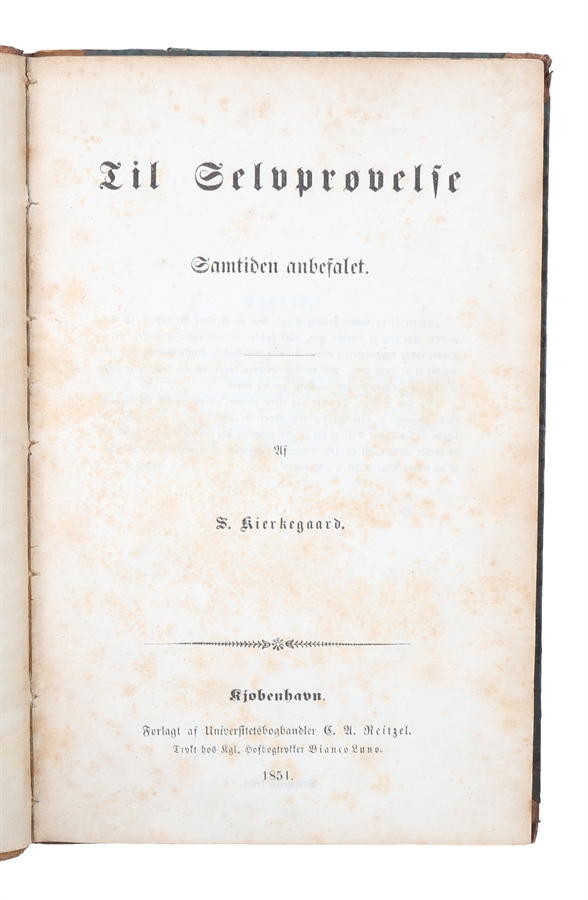
Kjøbenhavn, C. A. Reitzel, 1851.
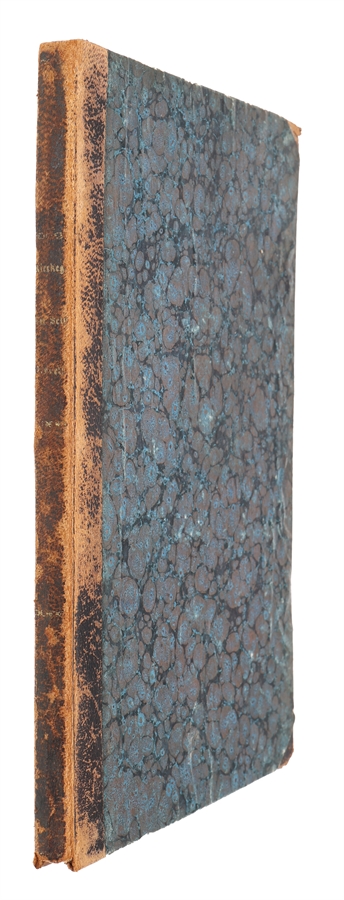
8vo. Contemporary brown half calf with marbled paper boards. Spine and corners worn. Title-page brownspotted and brownspotting throughout. Occasional light pencil notes. Ownership signature of Henning Kehler to front free end-paper. (4), 92 pp.
First edition with an excellent provenance. Described by Hong & Hong as written with “the metaphorical imagination of a poet, the thoughtfulness of a philosopher and theologian, the whimsy of the humourist, and the ardour of the lover and believer” (The Essential Kierkegaard, p. 393), “For Self-Examination” is widely considered one of Kierkegaard’s most accessible works and his most readily comprehended book. Thus, although written at the end of his career, it serves as an excellent introduction to his thought. “For Self-examination” is particularly famous for its well-known passages on Socrates and its critique of the established order of Christendom that was first hinted at in “Training in Christianity”. The work appeared on September 12, 1851, about a month after “Two Discourses at the Communion on Fridays” and “On My Work as an Author”, but as opposed to those two works, the genesis of which was protracted over almost two years, the present work was an act of idea to reality in a single summer, that of 1851. In this direct and approachable work published under Kierkegaard’s own name, he returns to the inward and the personal, to the individual before God. The work is divided into three sections that comprise a sort of trinity; the first is entitled What is Required in Order to Look at Oneself with True Blessing in the Mirror of the Word?, and the two following sections are on Christ and the Holy Spirit respectively. The book sold well, as is evidenced by a second edition appearing already in February 1852. Kehler, Henning (1891-1979): Critic, journalist, and book collector. Kehler was an important literary critic and especially influential in the years between to two world wars, where he excelled in sharp, conservative criticism of contemporary affairs. He wished to revitalize Danish culture and was worried about the contemporary materialism and lack of God. Kehler’s collection, broadly focused on Danish literature, included a significant collection of Kierkegaard. Himmelstrup 136.
Order-nr.: 62810