
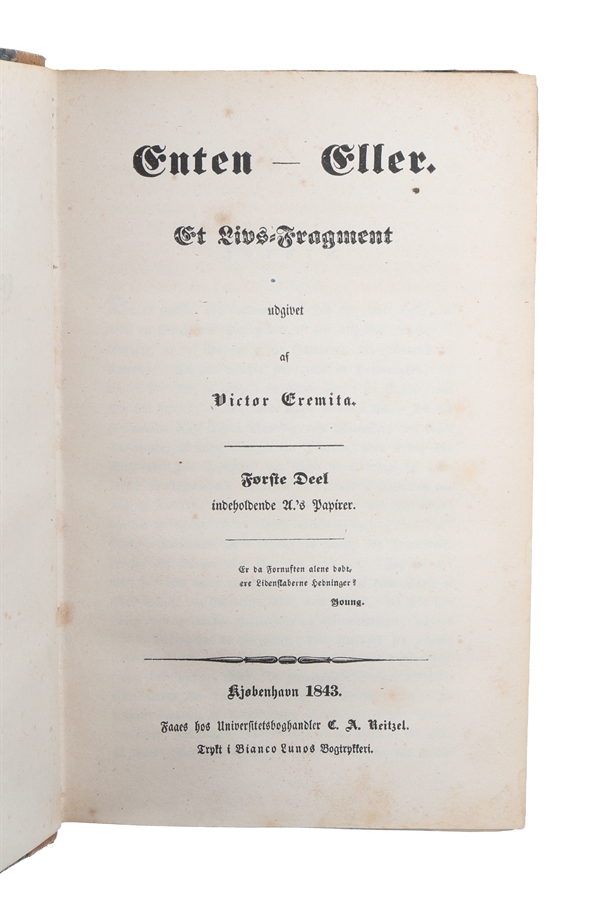
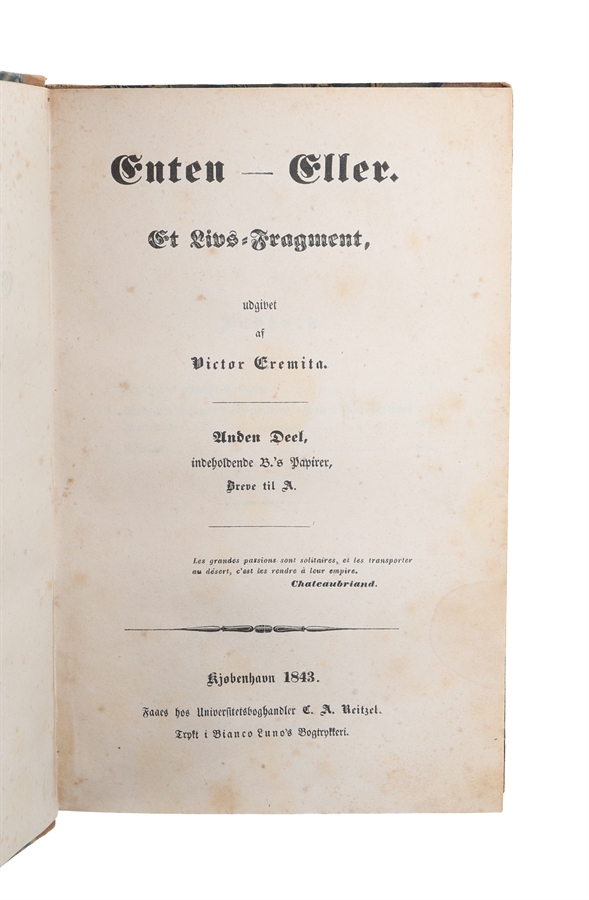
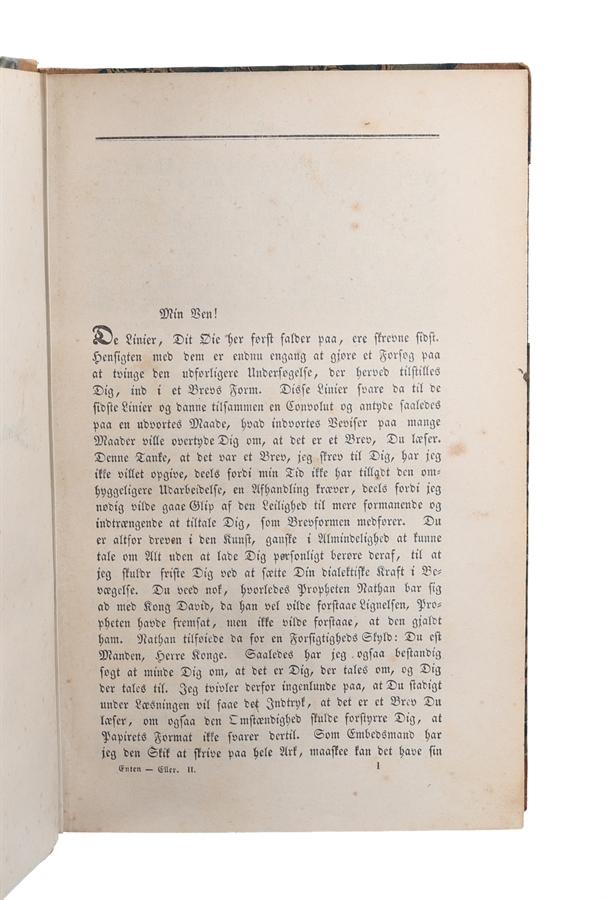
Kjøbenhavn, C.A. Reitzel, 1843.
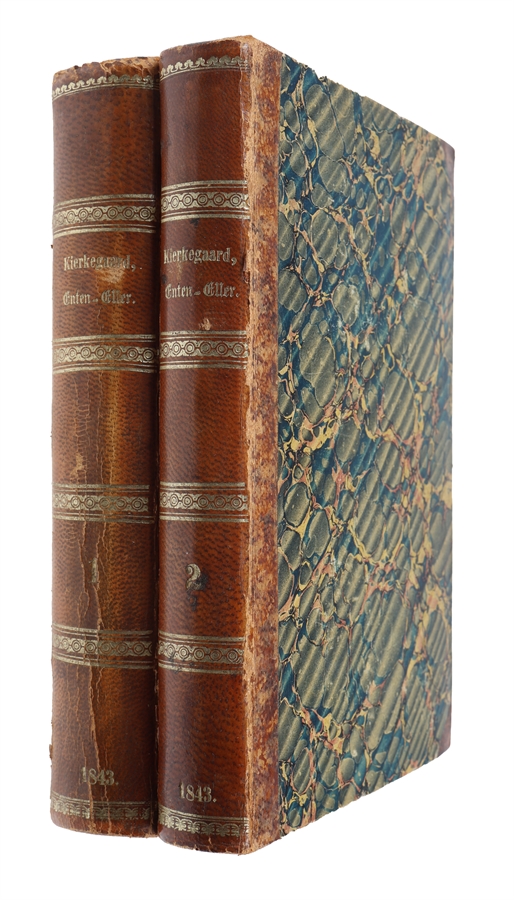
8vo. Two nice slightly later (ca. 1870'ies), brown uniform half calf bindings with gilt spines. Corners and spines with a bit of wear and internally some brownspotting to some leaves (as usual, due to the quality of the paper), mostly in the beginning, and mostly to volume one. Volume one also a little weak in the stitching. Overall a very nice copy, with the often lacking half-titles. XX, (2), 470; (8), 368 pp.
A very nice, fully complete copy of the first edition of the work that founded existentialism, by the greatest Scandinavian philosopher of all times, who "is now generally considered to be, however eccentric, one of the most important Christian philosophers" (PMM 314). Kierkegaard's monumental magnum opus is now not only the title of Kierkegaard’s most famous and widely read work, it is also a phrase that summarizes much of the thinking for which he is best known. It is a cornerstone of what we now characterize as Existentialism, and it seminally influenced later as well as contemporary philosophy. It quite simply ranks as one of the most important works of philosophy of modern times. It could be argued that Either-Or – Kierkegaard’s magnum opus, the foundational work of Existentialism and an inevitable classic in the history of philosophy – needs no further introduction. Who does not know this epochal work that founded Existentialism and introduced, among many other theories, Kierkegaard’s stage theory? It seems, however, a little off not to mention a few points about this groundbreaking work that has so profoundly influenced the way we view the world. Either-Or is the earliest of Kierkegaard’s major works and the work with which he begins his pseudonymous authorship. Kierkegaard’s pseudonymity is an entire subject unto its own. The various cover names he uses play a significant role in his way of communicating and are essential to the understanding of his philosophical and religious messages. And it all properly begins here, with his groundbreaking magnum opus. Conjuring up two distinctive figures with diverging beliefs and modes of life – the aesthetic “A” of Part One, and the ethical B (note that this is the first “pseudonym” that Kierkegaard uses, in his earliest articles)/Judge Vilhelm of Part Two, Kierkegaard presents us with the most basic reflections on the search for a meaningful existence, seen from two completely different philosophical views. This masterpiece of duality explores the foundational conflict between the ethical and the aesthetical, providing us along the way with the now so famous contemplations on music (Mozart), drama, boredom, pleasures, virtues, and, probably most famously, seduction (and rejection – The Seducer’s Diary). It is primarily Judge Vilhelm from Part Two of Either-Or that has bestowed upon Kierkegaard the reputation as the Father of Existentialism. His emphasis on taking ownership of oneself and the importance of making choices has made him the (first) personification of Existentialism and the idea that one does not passively develop into the self that he or she should be or ought to become. Kierkegaard went to great lengths to ensure that the public would not know the identity of the author was of Either-Or. He even had the draft of the work done by several hands, so that employees at the printer’s would also be deceived. Despite his efforts, however, it did not take long for the public to guess that Kierkegaard had written this astounding work. But Kierkegaard himself kept up the façade and did not accept authorship until several years later. "Either-Or" is very rarely seen in nice, contemporary or near contemporary bindings, and when it is, it is very rarely in good condition. Himmelstrup 20 PMM 314.
Order-nr.: 62091