
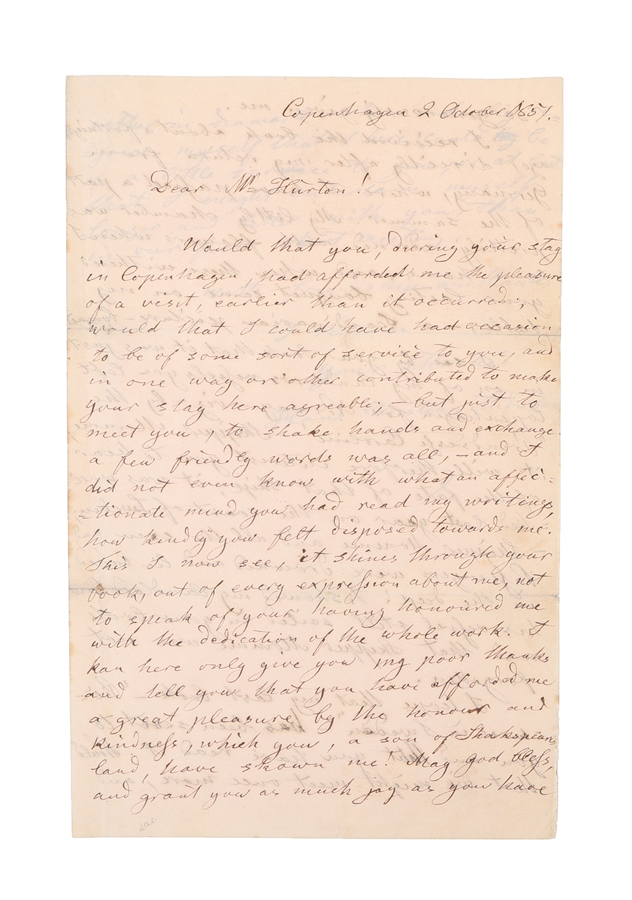
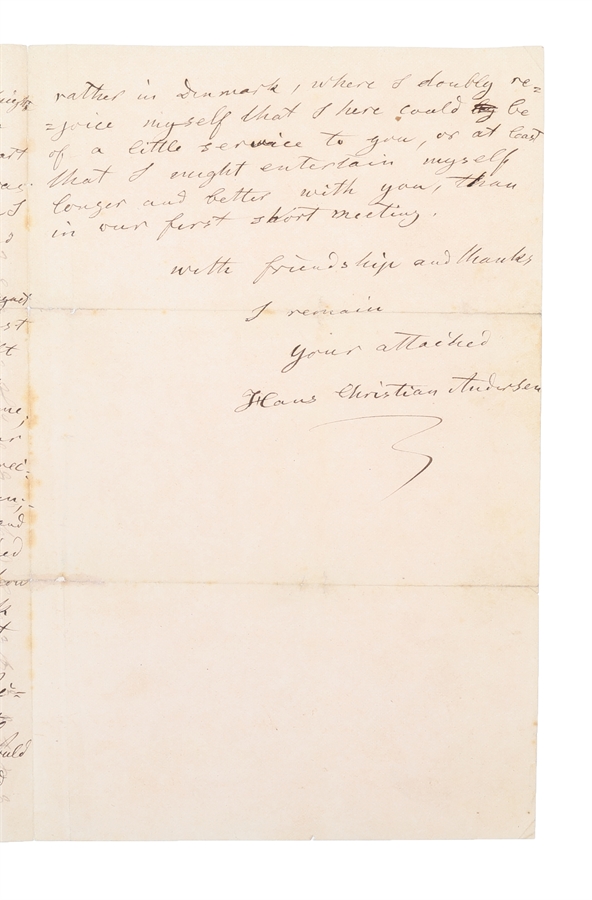
Dated "Copenhagen 2 October 1851"
2 ½ closely written pages, measuring 21x13,5 cm.
Exceedingly scarce letter from Andersen - one of only very few letters known by Andersen in English, and in Latin handwriting. In the fall of 1851, William Hurton had published a book entitled Voyage from Leith to Lapland; or, Pictures of Scandinavia in 1850, which he dedicated thus to the greatest Scandinavian writer of the era: "To/ Hans Christian Andersen,/ these pictures of his Scandinavian home/ are inscribed,/ by his friend and admirer,/ William Hurton. London,/ May, 1851." The book contains many lengthy references to Andersen – even a part biography of Andersen. Andersen was very touched by the gesture and by Hurton's flattering and lengthy portrayals of him, his life, and his work. The two authors had met in Copenhagen in 1849/early 1850 and formed an immediate friendship. In the present letter, which is both very interesting and very emotional, Andersen writes to Hurton, addressing him "a son of Shackespears Land", saying that he regrets not having met Hurton sooner and not having had the opportunity to do more for him while he was in Copenhagen. The expression of his gratitude for Hurton's dedication and portrayal of his authorship is both very sincere, very profound, very heartfelt, and very touching. He refers to receiving the book upon returning from Germany and describes how it reminded him of a bouquet of flowers in his living room. He also writes about the ship that Hurton travelled with, Caroline, how it went down and that the captain, crew, and passengers all died. Andersen ends the letter by saying that he hopes Hurton has received his latest book ("I Sverrig") and that he looks forward to hopefully seeing him again soon in Copenhagen. The present letter is of the utmost interest, as it is written in English (in Andersen's own hand!) and also in Latin characters, as opposed the gothic handwriting that Andersen usually uses. Letters and inscriptions in Andersen's Latin hand are of the utmost scarcity. He only used this handwriting when writing to a recipient not very familiar with Gothic writing, e.g. Englishmen (and also Swedes). Out of the few known letters in Andersen's hand, we have even fewer letters by him written in English. His English was very poor, and he did not correspond very much with English-speaking people. He made an exception for William Hurton, though, to whom a few letters have been preserved, demonstrating his reverence for this Scottishman so fascinated by Andersen himself. Almost all of these letters are in institutional holdings, and the present one on private hands is a true scarcity. Andersen did not know enough English himself to actually write the letter in English in the first go, and he thus draughted a letter in Danish (this Danish version is very well known and is reproduced in e.g. Bredsdorff, Andersen og England, pp. 277-78). This Danish version was then translated, possibly by his benefactor and friend Edvard Collin. Collin did know English, but was not fluent in the language, which the letter also indicates. After having a translation in front of him, Andersen then wrote the letter again, in his own hand, in Latin handwriting, and in English, which is the result that we have in front of us.
Order-nr.: 63545