
London, William Pickering (Chiswick), 1846.
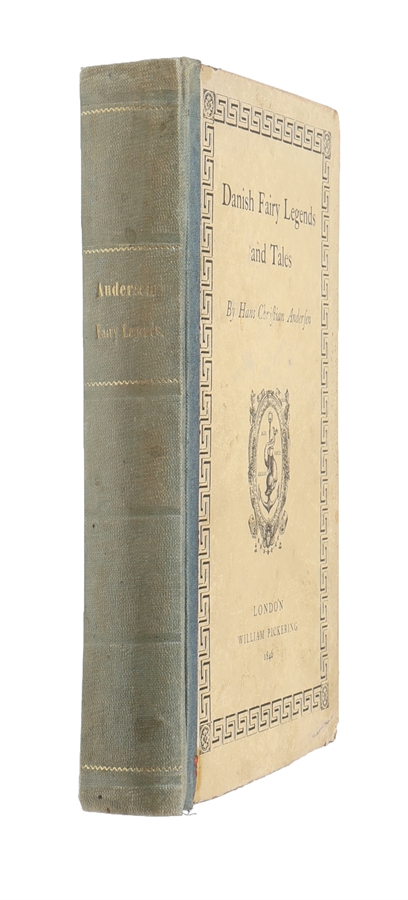
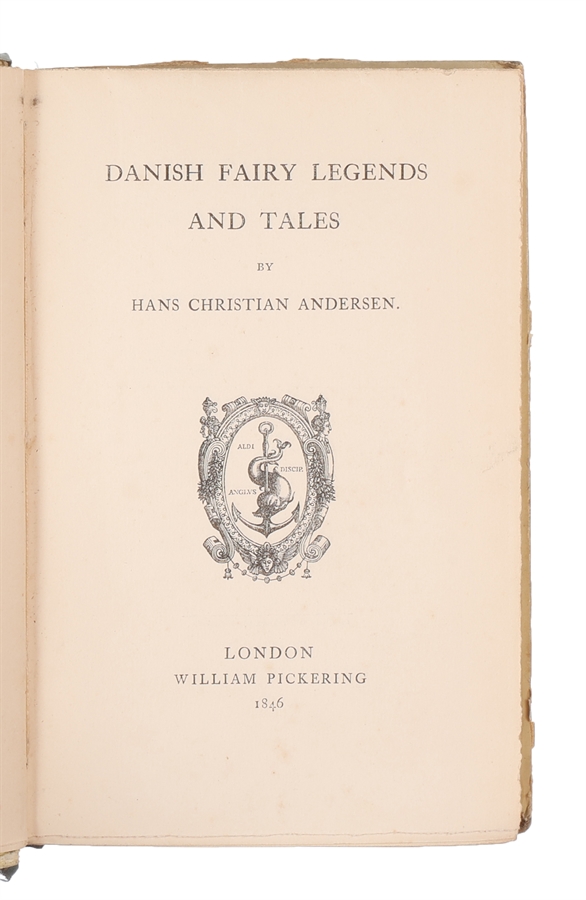
Uncut in original printed cardboard boards - front board with printed title, author, printer and printer's device within a meander border, back board with an ornamental centre-piece within a meander border. Contemporary light green-blue cloth spine with gilt title and gilt lines. Boards with light soiling and spotting, a bit of wear to extremities and inner front hinge weak. Free end-papers with brownspotting, otherwise internally very nice and clean. With the owner's name of Henriette Scavenius (born Moltke) to front free end-paper. An excellent copy of this beautifully printed book. With the Aldine-inspired printer's device on front board and title-page and the Charles Whittingham (Chiswick, 1846) -device on verso of last leaf. (6), 197, (3) pp. With the scarce advertisement-leaves at both beginning and end.
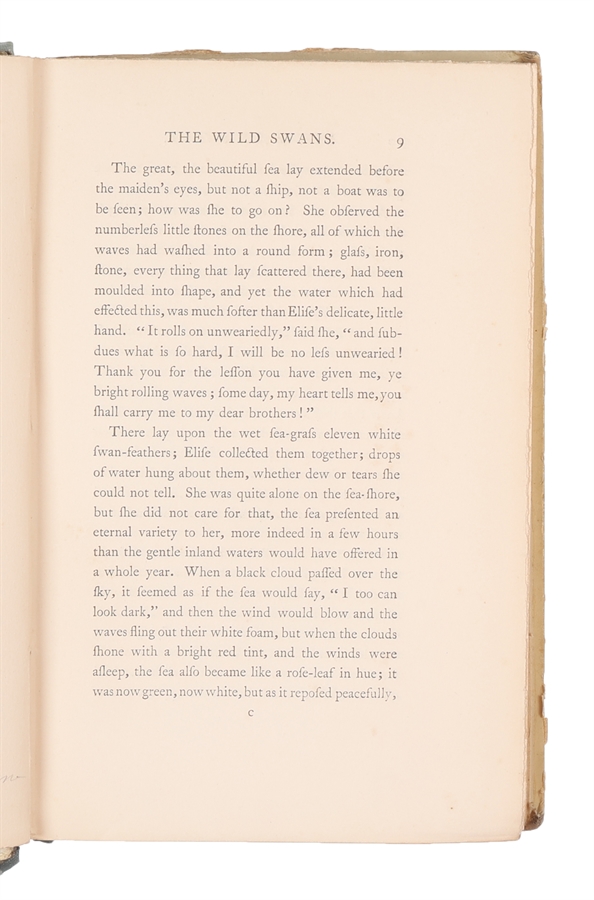
The very rare first edition – ANDERSEN'S CLOSE FRIEND HENRIETTE SCAVENIUS' (BORN MOLTKE) COPY – of this highly important Andersen-translation, which contains the very first appearance in English of some of Andersen's most famous and beloved fairy tales: "The Emperor's New Clothes, "The Nightingale", "The Wild Swans", "The Buck-Wheat" and "The Dustman", and for the first time we here find the titles "The Ugly Duckling" (previously called "The Ugly Duck") and "The Real Princess" (previously called "The Princess and the Peas"). The fairy tales were originally written in Danish, printed between 1835 and 1844. The present work constitutes the third Andersen fairy tale collection to appear in English. It appeared in May 1846 and contains 14 fairy tales translated by Miss Caroline Peachey; the above-mentioned five were printed for the first time in English. The preceding two translations contained 10 and 12 fairy tales. The first was translated by Mary Howitt and printed earlier the same year ("Wonderful Stories for Children", London, February 1846), but not containing the same fairy tales. It comprised nine of the oldest fairy tales and one more recent one. Shortly after Howitt's translation, Charles Boner's appeared under the title "A Danish Story Book", containing 12 fairy tales, all translated from German. The translations of this third collection are said by Peachey to have been made from the Danish, which was not very common – mostly, German translations from Danish would be used for the English translations. As early as during the 1830'ies, Andersen's works began to appear in German translations, and Andersen anxiously kept an eye on the success of his works in other European countries. He was very eager to have his works translated into other European languages, and as soon as the German translations began to appear he began thinking about English and French translations. In 1837 he states in a letter to Henriette Hanck: "Gid jeg maate opnaa den Glæde, at en af mine Romaner kom ud paa Engelsk; det ville fornøie mig særdeles; dog, paa Fransk skaffes nok flest Læsere..." (Bredsdorff, Andersen og England, p. 42) (i.e.: "I wish to gain the pleasure of one of my novels appearing in English; it would bring me great joy; though, in French there will probably be more readers to be found..." [own translation]). The first work by Andersen to appear in English is "The Improvisatore", in 1845, but it is with his fairy tales that Andersen begins to gain the world-wide fame that he possesses today. The fairy tales had a great impact in England, which is reflected by the fact that the number of publications grew rapidly: nine collections in the span of two years, 1846-47, 44 texts in total (Jørgensen 1996: 19). According to Jørgensen (1996), the reception in England showed a deeper understanding of the genre's artistic character than the Danish contemporary critics (1996: 19). In fact, it was the case for his work that "its national recognition was fostered by its international circulation rather than the reverse" (Thomsen 2025: 8). It is with these three mentioned fairy tale collections of 1846 as well as the two following, that Hans Christian Andersen makes his entrance on the English-speaking market. According to Bredsdorff (1954), the most important translators of Andersen's fairy tales in the period 1846-1875 are the following eleven: Mary Howitt, Charles Boner, Caroline Peachey, Meta Taylor, Charles Beckwith Lohmeyer, Madame de Chatelain, Anne S. Bushby, Alfred Wehnert, H.W. Dulcken, Mrs. H.B. Paull and, in collaboration with several others, Augusta Plesner. Furthermore, "[t]he first five of these possess the honour of having made the fairy tales known in England between 1846-1848, and their versions of H.C. Andersen's fairy tale are thus of particular interest." ([own translation] Bredsdorff 1954: 489). ------------------------------------------------------------------------------ HENRIETTE SCAVENIUS was born Countess Molkte. She married Jacob Brønnum Scavenius of Basnæs estate. As is well known, H.C. Andersen spent a great part of his time on Danish estates, about 5 years all together, and one of his favourite places was Basnæs, where he spent time with his close friend Henriette Scavenius. He is supposed to have visited Basnes and Henriette Scavenius 37 times and spent about 15 months there over the years. When he was not visiting Basnes, Andersen corresponded frequently with Henriette Scavenius, and a vast number of letters to her from Andersen are known and have been preserved. Bredsdorff, Elias L. (1954). Hans Christian Andersen og England. pp 489-522. Jørgensen, Aage (1996). H. C. Andersen i Europas Spejl. zusammenfassung: H. C. Andersen im Spiegel Europas. In Niels Oxenwad (ed.), Andersiana. pp. 5-40. H. C. Andersens Hus, Odense. Thomsen, T. B. (2025). Andersen Abroad: Literary Circulation in Nineteenth-Century Europe. Journal of World Literature, 10(2), 193-212. Article 3. https://doi.org/10.1163/24056480-01002003
Order-nr.: 63461