

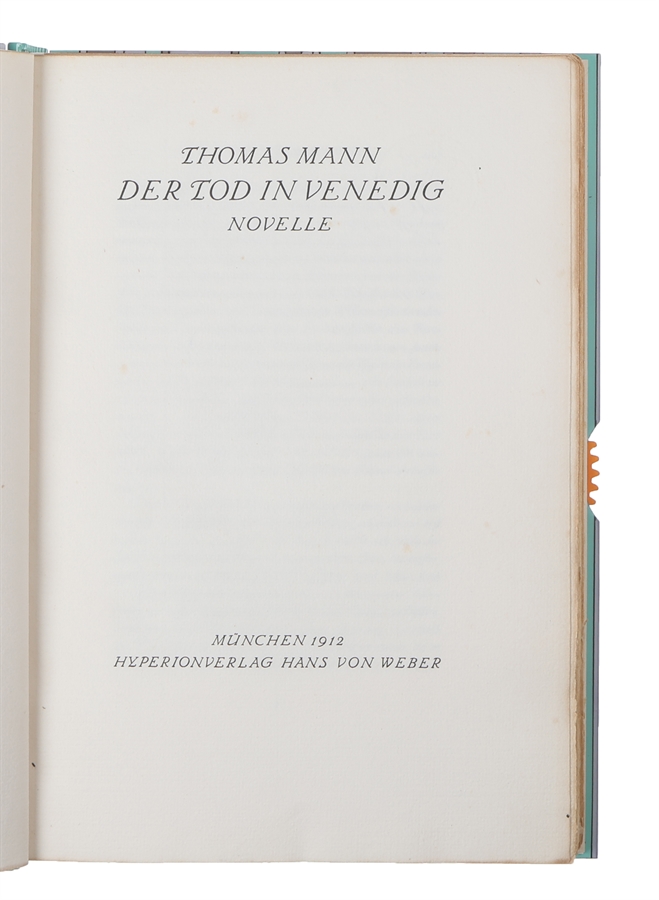

München, Hyperion Verlag Hans von Weber, 1912.
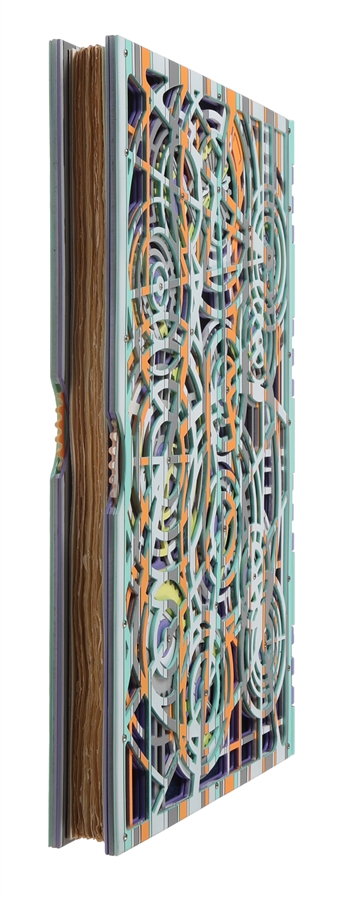
Large 4to. (Binding: 283 x 205 cm). Bound uncut, with top edge gilt, in a truly magnificent, innovative mechanical binding, made of light grey polycarbonate, by Edgard Claes. Internally very nice and clean, with only a few occasional very minor light brown spots. Printed on thick, heavy paper (Büttenpapier) with watermarks. (1), 97, (1) pp.
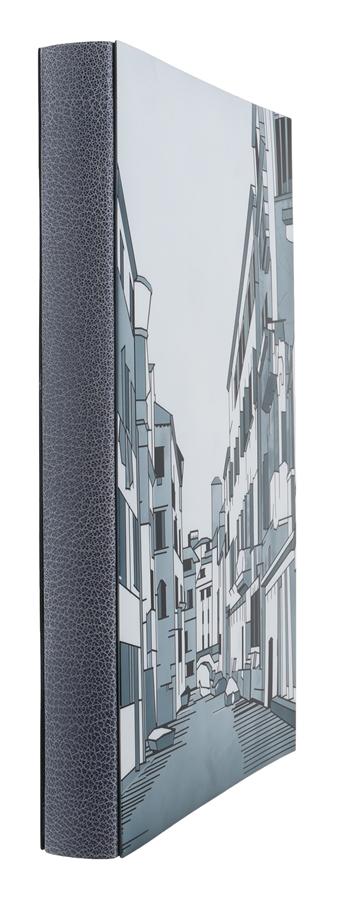
The splendid binding, made of polycarbonate with mechanical boards, is housed in a wonderful illustrated polycarbonate chemise with a blue morocco spine, again housed in a highly decorative polycarbonate slip-case with removeable spine.
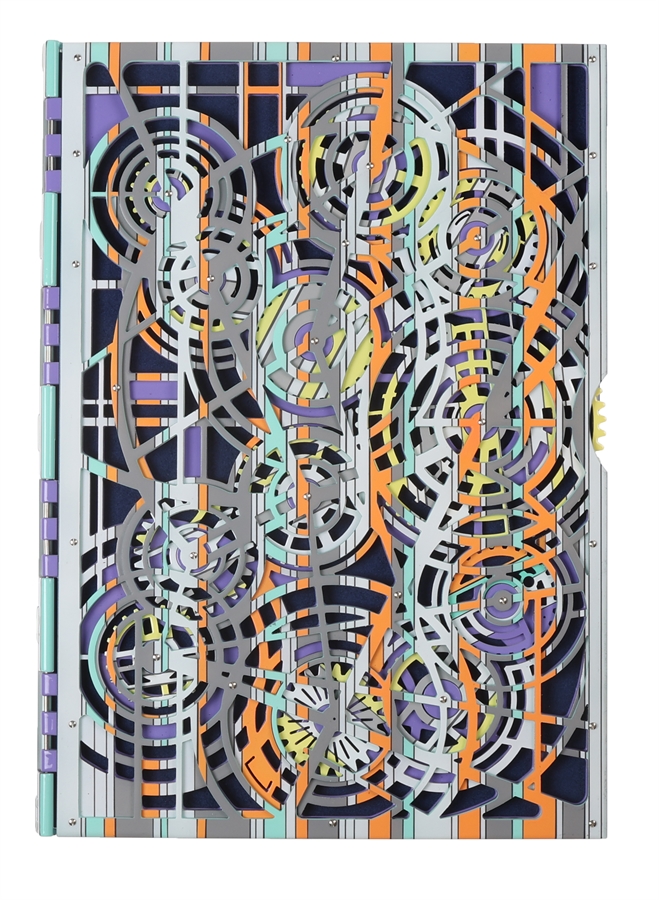
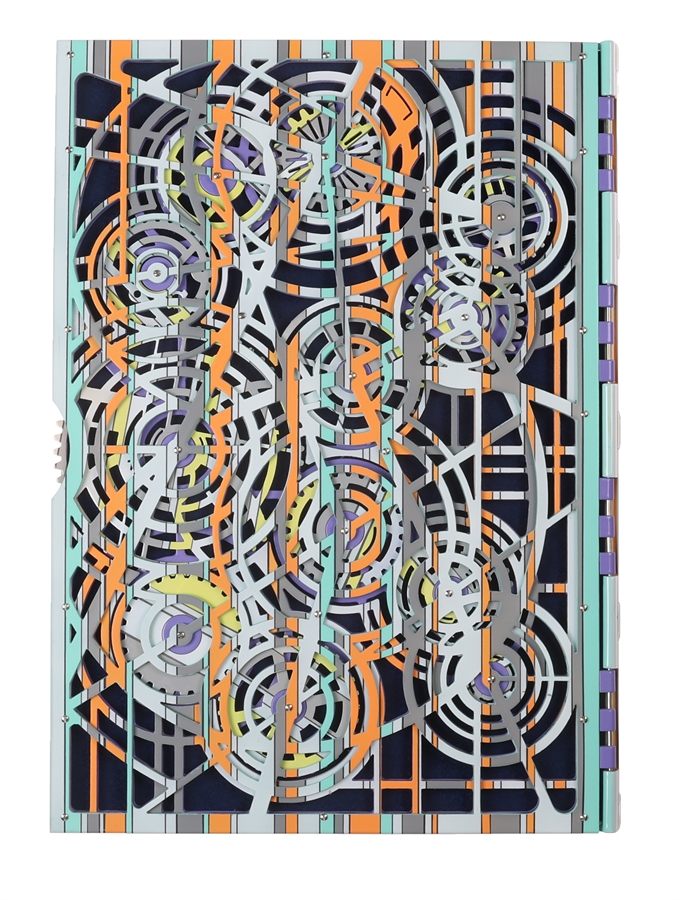
The boards, with exposed hinges, are with numerous cut-out shapes revealing 12 cogwheels (to each board) of varying sizes inside. The boards consist of three layers, with the cogwheels in the middle; they are all striped in shades of orange, pastel blue, yellow and purple, white and grey. Five tips of the largest cogwheel on both boards protrude at the middle of the boards, so that the cogwheels can be turned, creating a mechanical mirage throughout the boards. The spine has the title and publishing year in black letters on white and grey vertical stripes. The block is bound with fishing line, which is visible on the upper and lower part of the spine. Dark blue velvet end-papers.
Both covers of the chemise with black/grey white illustration being a stylized vue of a Venice canal. Onside covered in blue velvet.
The highly decorative polycarbonate slipcase is in light grey with patterns in the same pastel colours as the binding. The slipcase has a sliding "spine" with title in the same colour. Inside of slipcase also covered in blue velvet.
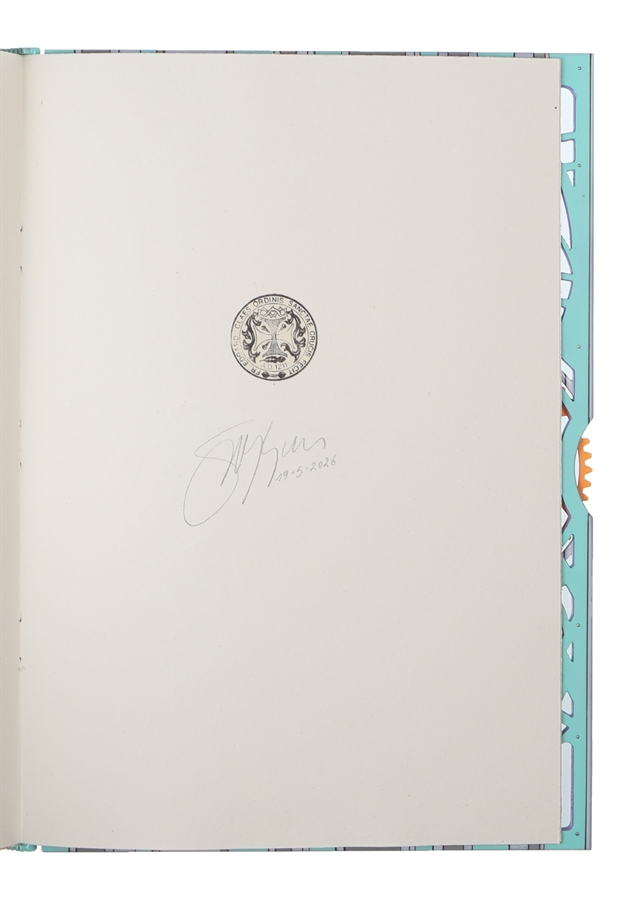
The book was bound in May 2026 and signed in hand (pencil) by Edgard Claes, on a blank leaf after the colophon. This leaf also carries a stamp of the monastery with Claes' name.
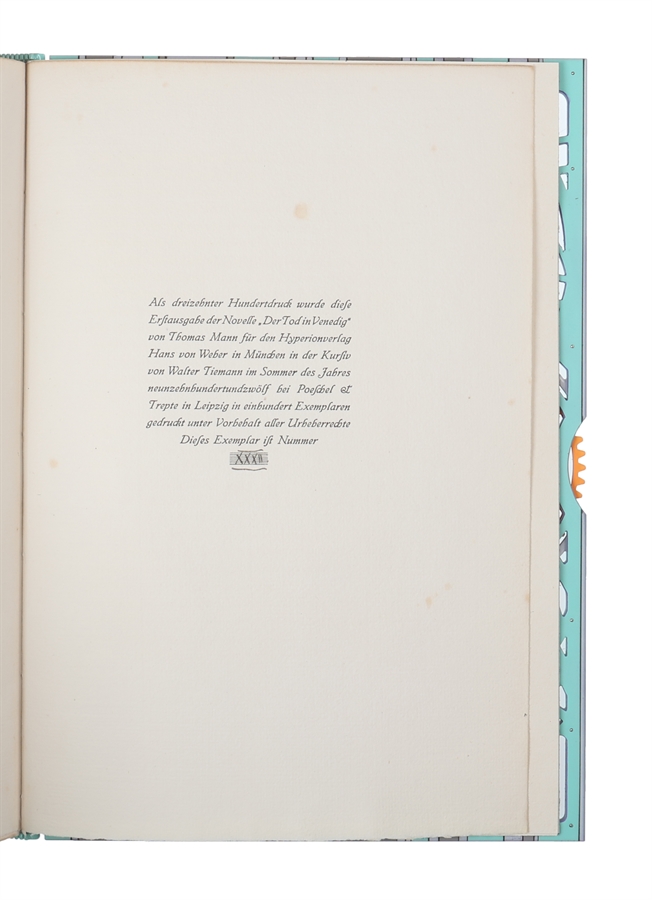
Very scarce first edition of Thomas Mann's disturbing masterpiece Der Tod in Venedig in a rare one-of-a-kind bookbinding by the renowned, international prize-winning bookbinder Brother Edgard Claes. Probably the most famous story of obsession ever written, "The Death in Venice" is considered one of the most important literary productions of the 20th century. This first edition of the book was printed in merely 100 copies, which are all numbered; this being copy nr. 32/100. Probably due to the controversial theme of the work, Thomas Mann was hesitant about immediately handing over the manuscript to his regular publisher S. Fisher and had settled on the bibliophile edition already before finishing the work. He did give Fischer the work to publish, though, and thus it came to appear both in Fischer's magazine "Neue Rundschau", in two volumes, and with Weber's Hyperionverlag. While the first part of the work was being published, the luxury edition was being prepared, and in the end, the luxury edition was only issued (shortly) after the second and final part had appeared in November 1912. The first trade edition appeared in 1913. Katia Mann, Mann's wife, wrote in her memoir from 1974 that he had not intended to write this novel, which he ended up working on for a whole year. He wanted to write a novel about Goethe but did not believe he was up to such a task yet. Thus, he transposed the Goethe novel into Death in Venice (Mann 1975: 60). The physical apperance of the character Aschenbach was inspired by Gustav Mahler's situation before he died: While in Venice in 1911, Mann was following the bulletins reporting Mahler's condition. The Manns knew and had met Mahler personally: "My husband told me that Gustav Mahler was the first person he'd ever met who gave him the impression of being a great man" (Mann 1975: 65). Mann also attributed to Aschenback the works he himself never completed. Overall, the story was inspired from several real-life experiences, icluding their travels to Brioni, the cholera epidemic in 1911, and the fascination with a charming Polish boy, as described in detail in Katia Mann's memoirs (see Mann 1975: pp. 60-67). "The whole thing had an interesting epilogue. Death in Venice was a great success, especially in America, and the novella is certainly one of my husband's best. A few years ago Erika received a letter from an elderly Polish aristocrat, a count, who wrote that something funny had happened. Some time ago friends had brought him the Polish translation of a novella in which he an his whole family were described to a T; he found this very amusing and intriguing. But he was not offended. Such was the end of the 'real' story." (Katia Mann 1975: 63-64) The binding: Brother Edgard Claes, monk in the Crosier Order, was born in Belgium and now lives and works in the Monastery of Saint Agatha, the oldest inhabited monastery in the Netherlands, with only two other Crosier monks left. He is one of the most prominent bookbinders in the world and his bindings are already ones of legend. He was educated as a classical hand bookbinder, but soon started looking for alternative and innovative forms and materials for his bindings. He studied at Instituut voor Kunst en Ambacht (IKA) in Mechelen, and later under the Belgian master bookbinder August Kulche (1927-2003). Edgard Claes is also an accomplished painter, sculptor, stained glass maker. Since 1990, he has been making his bookbindings mainly from polycarbonate, which he processes with a computer-controlled milling machine and colors with airbrush, using car paint and a clear varnish to finish off. These bindings, especially the "mechanical" ones, with moveable parts, are among the most interesting and sought-after modern bookbindings. They are totally unique and unlike anything one will have seen anywhere else, often reflecting on the contents of the book that they hold. They are, furthermore, few and very scarce. In 2025, there was a 3-year waiting period for new orders.
Sources and further reading: For more on Edgard Claes, the magnificently innovative bookbinder, please see: https://edgardclaes.com/portfolio/bindereport/
Britannica Editors (2025, March 10). Death in Venice. Encyclopedia Britannica. https://www.britannica.com/topic/Death-in-Venice-novella-by-Mann Hul, Jan van 't. (2026, June 2). Boekbinder Edgard Claes: We sterven uit; de toekomst van de krusheren is dus nul. Reformatorisch Dagblad. https://www.rd.nl/artikel/1151249-boekbinder-edgar-claes-we-sterven-uit-de-toekomst-van-de-kruisheren-is-dus-nul Mann, Katia (1975). Unwritten Memories. New York: Knopf. Pascal, R. (2026, August 8). Thomas Mann. Encyclopedia Britannica. https://www.britannica.com/biography/Thomas-Mann
A symbol-laden story of aestheticism and decadence: "[S]ymbols of eros and death weave a subtle pattern in the sensuous opulence of this tale" (Pascal 2026). As in other of Mann's works from the start of the 20th century, he here explores the role of the artist in society. It also exemplifies the author’s regard for Sigmund Freud’s writings on the unconscious. This work closes an epoch of Mann's work. (see Britannica, 2025)
Order-nr.: 63412