
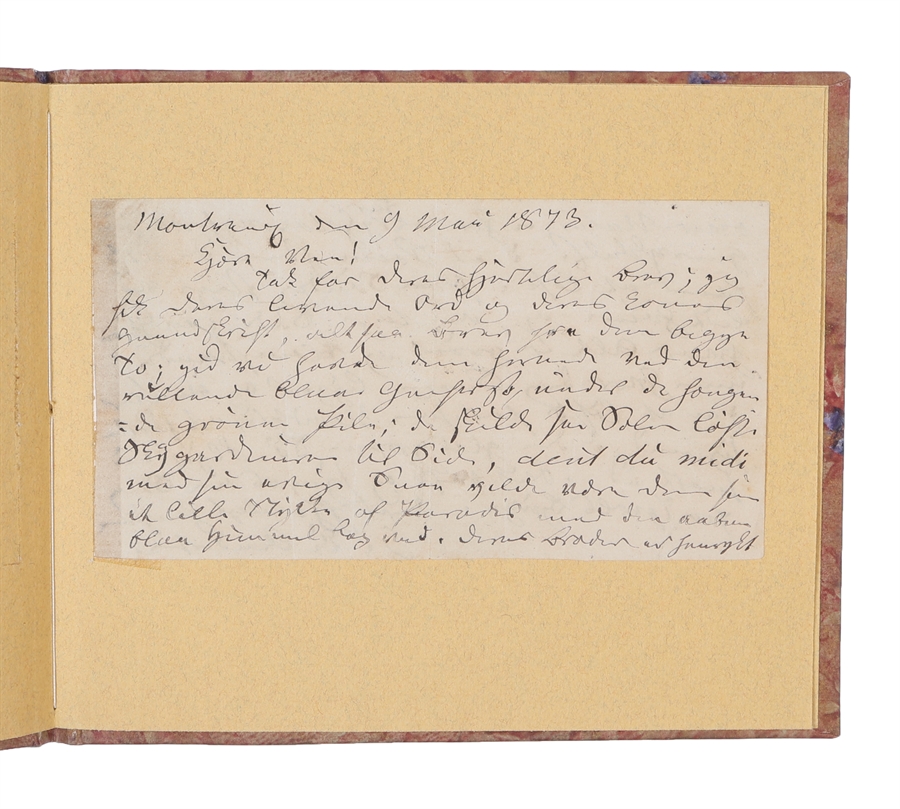
Dated "den 9 Maj 1873".
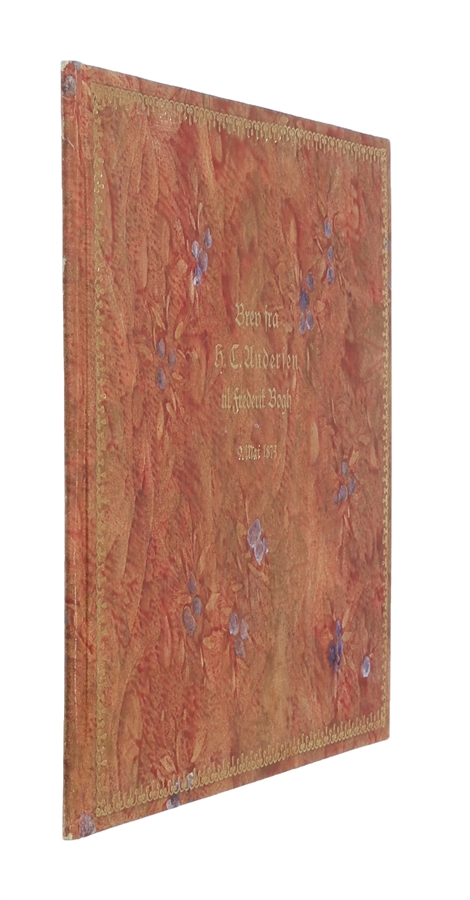
2 pages 12mo. In a beautiful marbled paper binding with gilt ornamental borders to boards and gilt lettering to front board (signed Rigmor Birkedal Kragh).
Original handwritten letter from Andersen to his close friend Frederik Bøgh. This Beautiful little letter for Frederik Bøgh bears witness to the heartfelt bond that Andersen felt towards his young friend. This little gem of a letter is very poetical – most of it is almost like a poem, describing the sun coming through the clouds and likening the clouds to snow and the heaven to Paradise. Furthermore, Andersen mentions his friends’ illness, likening him to a bird that needs to be free. Bøgh had fallen ill the previous year, from an illness that would eventually kill him 9 years later, at the mere age of 45. Later research has shown that he had sclerosis. The letter is published in the Andersen letter database. The full contents are: "Kjære Ven! Tak for Deres hjærtelig Brev; jeg fik Deres levende ord og Deres Kones Haandskrift, altsaa Brev fra Dem Begge To; gid vi havde Dem hernede ved den rullende, blaa Genfersø under de hængende, grønne Pile. De skulde se Solen løfte Skygardinerne tilside, Dent du midi med sin evige Sne vilde være Dem som et lille Stykke af Paradis med den aabne blaa Himmel bag ved - - - Paa Søndag stige vi lidt højere op, vi tage Sæde paa Glion, hvor Alt er grønt og blomstrende, men hvor dog Sneen ligger og venter paa at løses for som et Vandfald at styrte sig ned i den glasgrønne Sø. Flyv nu snart ud, bliv rask, og syng os en Sang fra Tyrols Bjerge. Deres hjærtelig hengivne H. C. Andersen." Frederik Bøgh (1836-82) was born into a literary and artistic home North of Copenhagen. His uncle was a priest at Garnisonskirken in Copenhagen, and at the age of nine, Frederik was sent off to a good school in Copenhagen, where he could live with his family. It was here, in Copenhagen and at the vicarage where many famous people of the period often gathered, that he met Hans Christian Andersen, to whom he grew very close. Andersen recognized true potential in Bøgh, who sadly died at the age of 48, after almost a decade of being ill. His last ten years were not good and put a stop to his otherwise promising literary career. Frederik had a keen interest in literature, which only grew stronger through his meetings with the literary nobility of Copenhagen. On his 25th birthday, November 4th 1861, he published a work called Valkyrien. The book was quite well received, but it was published anonymously, and the identity of the author was the object to many a speculation. In his diary, Andersen writes on November 10 1861: “I found out for sure that 'Valkyrien' was by the young Bøgh! It is a particularly promising work.” Andersen is very impressed with the young budding author, and Frederik, of course, is overwhelmed by the kindness of the greatest Danish writer, whom everyone had grown to admire. In a letter on November 18, Frederik writes to his parents: “On this occasion, H.C. Andersen has met me with overwhelming love. He had quite loosely heard that I was said to be the author, and when he had read the book, he immediately sat down to write to the author; but where was he to deliver it [i.e. the letter]? After that he had gone to Collins and said 'I know from a reliable source that it is him – ay, I will run there immediately'. 'You cannot do that', Collin had said, what if it is not true. Think of the uncomfortable position you will put the young man in!' After that, he had wandered back and forth in front of a certain vicarage in Bredgade, without the courage to enter. And yet – next morning he came, but he did not find me home, and I went to him. He received me with the extraordinary cordiality that is so peculiar to him: 'First I must tell you that I do not like these heroic women, who lack all femininity. So, I then began reading the book with great reluctance; but when I had read a bit, I said to myself: “But he is brilliant!”, and the more I read, the more I was overcome by joy. Your book is quite poetical. It is the most important that has appeared since it went quiet [i.e. since the great author Oehlenschläger died in 1850]. All the others have twittered as little birds; but you give more, you give something objectively. I am so very pleased about that; that is wonderful, and now, you will see, the sunshine will come, it will come!' and then he pressed both of my hands so warmly, looked me in the eyes so lovingly, got tears in the eye – and I too. We felt good about each other, and happy and pleased I left him.” The warm bond between Frederik Bøgh and Andersen can be traced back to this moment. And from then on, a close friendship evolves, which is evident from their correspondence. And although the young author showed such great promise, he did not publish another book in his lifetime. In the spring of 1872, at the mere age of 35, disaster struck: Frederik Bøgh suddenly fell ill. In the biography about him that his wife wrote in 1887, it is described thus: "His hands lost strength and he could not walk. Little did we know that these were the certain symptoms of the spinal cord disease that he had built up for so long and which was now slowly working its way forward". It is this horrible illness that Andersen alludes to in the last of the letters that we have gathered here, dated about a year after Fredrik first fell ill, where he poetically describes how he ought to be set free and fly freely about. Later that year, in 1872, Andersen writes in his diary “then Frederik Bøgh came. He talked sickly, called himself 'the cripple', confided in me that for more than a year he had lived with the thought that I was upset with him, that I had felt disappointed with his gift as a poet… I wrote a few warm words in a copy of my new book and he walked away happily.” “The Cripple” was the title of a new fairy tale that Andersen had written and that Fredrik Bøgh had just reviewed. He presumably identified with Andersen’s “Cripple”, who was described as “the liveliest and nicest child, but then suddenly he became 'floppy in the legs', as they called it, he could not stand or walk and now he was lying in bed for the fifth year.” It would only be another three weeks till Frederik Bøgh took his last steps on the streets, December 14th, 1872. After that he completely lost the strength in his arms and later also his eyesight. Due to his wive’s thorough description of the symptoms in his biography, later research has been able to determine that he suffered from sclerosis, an illness that would eventually kill him 10 years later, on January 31st 1882. At the time, the illness was a mystery and the doctors had no clue what to do. Apparently, the description in the biography constitutes the first described case of disseminated sclerosis in Denmark.
Order-nr.: 63550