
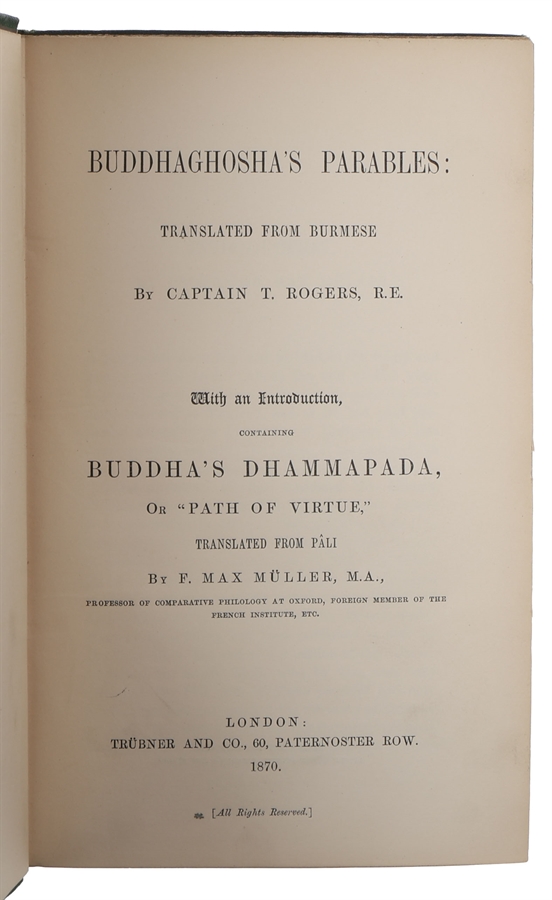
London, 1870.
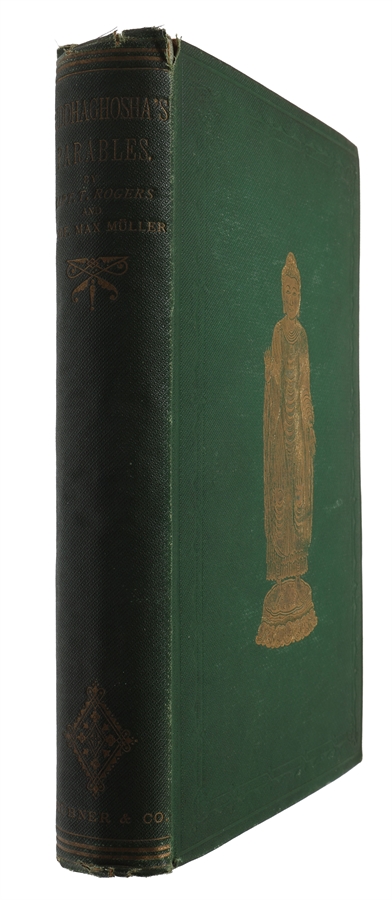
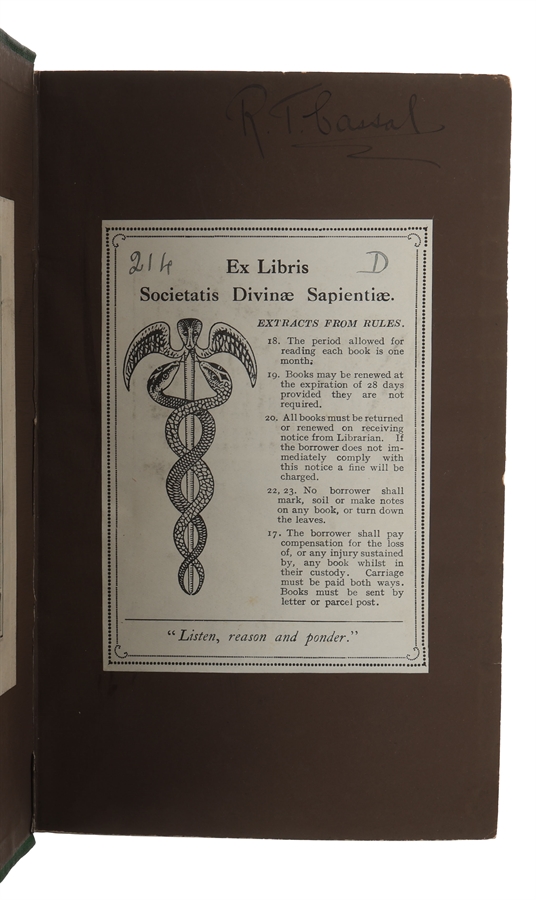
8vo. Original green full cloth with gilt lettering to spine and gilt illustration of Buddha to front board. Spine a little darkened and wear to capitals. Inner front hinge open and partly cracked, but still honlding. Inner back hinge weak. Unopened and internally very nice, clean, and fresh. With the large book plate of Ernest Ridley Debenham to inside of front board and ex Libris of Societatis Divinae Sapientiae to front free end-paper, along with old owner's signature. CLXXII, (206), 24 (advertisements) pp.
Scarce first edition of the highly influential first English translation of the Dhammapada, along with Buddhaghosha’s Parables. Excerpts of the Dhammapada had appeared in English in the periodical The Friend printed in Colombo, Sri Lanka, but a full English translation, which is based upon Fausböll’s version (from 1855, being the first European edition of a complete Pali-text as well as the first Latin translation of the Dhammapada), only appeared in 1870. Today, the Dhammapada is probably the most frequently translated Buddhist text in the world. The Dhammapada, the extremely influential collection of sayings of the Buddha in verse form, constitutes one of the most widely read and best known Buddhist scriptures. The original version of the Dhammapada is in the Khuddaka Nikaya, a division of the Pali Canon of Theravada Buddhism. Each saying recorded in the collection was made on a different occasion in response to a unique situation that had arisen in the life of the Buddha and his monastic community. “The Dhammapada is the best known and most widely esteemed text in the Pali Tipitaka, the sacred scriptures of Theravada Buddhism. The work is included in the Khuddaka Nikaya ("Minor Collection") of the Sutta Pitaka, but its popularity has raised it far above the single niche it occupies in the scriptures to the ranks of a world religious classic. Composed in the ancient Pali language, this slim anthology of verses constitutes a perfect compendium of the Buddha's teaching, comprising between its covers all the essential principles elaborated at length in the forty-odd volumes of the Pali canon.” (The Dhammapada. The Buddha's Path of Wisdom. Translated from the Pali by Acharya Buddharakkhita with an Introduction by Bhikkhu Bodhi, 1996). Buddhist tradition has it that shortly after the passing away of the Lord Buddha, five hundred of his disciples met in council at Rajagaha in order to recall the truths they had received from their spiritual teacher during the previous forty-five years. They wanted these truths about moral and spiritual conduct to live on forever and for Buddha’s message to be available for all future disciples. The followers and Arhat felt the responsibility to convey the teaching and discipline of the Buddhist order as faithfully and truly as possible, and having no written texts to rely on, they prepared the many discourses for recitation with repetitions in various contexts, so that they could be remembered. Like the verses of Homer and other ancient works that were only written down later. “At that time, according to the Sinhalese, the Dhammapada was orally assembled from the sayings of Gautama given on some three hundred different occasions. Put in verse form the couplets contrast the vanity of hypocrisy, false pride, heedlessness, and selfish desire with the virtues of truthfulness, modesty, vigilance, and self-abnegation. The admonitions are age-old, yet they strike home today, their austerity of purpose fittingly relieved by gentle humor and earthy simile. Subsequently, several renditions of the Dhammapada in the Sanskrit and Chinese languages came into circulation; likewise, a number of stanzas are to be found almost verbatim in other texts of the canonical literature, testifying to the esteem in which its content was anciently held. Since first collated, the Dhammapada has become one of the best loved of Buddhist scriptures, recited daily by millions of devotees who chant its verses in Pali or in their native dialect.” (Bodhi, 1996). “The Dhammapada, an anthology of verses attributed to the Buddha, has long been recognized as one of the masterpieces of early Buddhist literature. Only more recently have scholars realized that it is also one of the early masterpieces in the Indian tradition of kavya, or belles lettres.” (The Dhammapada. A Translation. translated from the Pali by Thanissaro Bhikkhu). Buddhaghosha's Parables is a collection of Buddhist stories and moral lessons compiled by the Indian scholar and monk Buddhaghosha in the 5th century CE. The present first English translation includes 50 parables that illustrate various aspects of Buddhist philosophy and ethics. The stories cover a wide range of topics, from the importance of mindfulness and the dangers of attachment, to the virtues of compassion and the nature of enlightenment. Each parable is accompanied by a commentary that explains its meaning and relevance to Buddhist practice.
Order-nr.: 63105